
Deep Analysis of Chip Investment Logic: Why Now is the Golden Age for Semiconductor Layout
In today's increasingly fierce global technology competition, the semiconductor industry has become a core field of strategic competition among countries. With the rapid development of emerging technologies such as artificial intelligence, 5G communications, and the Internet of Things, chips, as the foundation and core of modern information technology, are increasingly highlighting their strategic importance. In recent years, the global chip investment boom has continued to heat up, with governments, enterprises, and capital increasing their investments, bringing unprecedented development opportunities to the semiconductor industry. This article will deeply analyze the core logic of chip investment from multiple perspectives including national strategy, market demand, and technological breakthroughs, revealing the investment value and future trends of the semiconductor industry.
National Strategy Level: Global Chip Competition Intensifies
The semiconductor industry has become a strategic high ground in technological competition between countries. The United States has invested $52 billion through the "Chip and Science Act" to support domestic chip manufacturing; the EU has launched the "European Chip Act" with plans to invest 43 billion euros to increase chip capacity; Japan has established a 2 trillion yen fund to support the semiconductor industry; South Korea has positioned semiconductors as a national strategic industry and continues to increase R&D investment. China has also listed the semiconductor industry as a key development area, explicitly proposing to accelerate the development of the integrated circuit industry in the "14th Five-Year Plan".
This global policy support provides a solid policy foundation for chip investment. Governments not only provide financial support but also offer comprehensive support in terms of tax incentives, land use, and talent cultivation, creating a policy environment conducive to the development of the chip industry. For investors, grasping the national strategic direction and choosing subdivided fields and enterprises that align with policy guidance will yield excess returns from policy dividends.
Southeast Asia: A New High Ground for Chip Industry Transfer
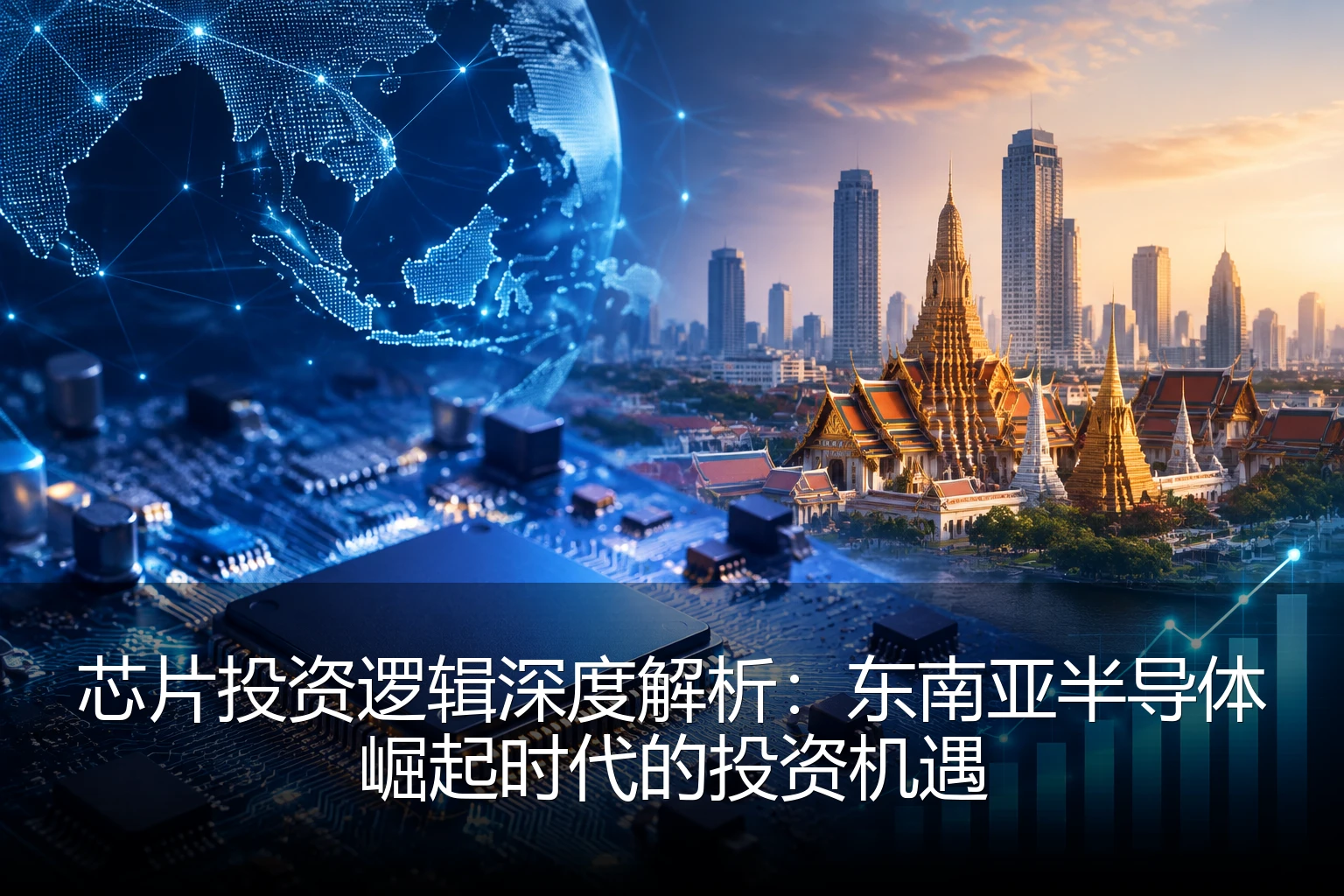
Against the backdrop of global supply chain restructuring, Southeast Asia is becoming a new high ground for global chip industry transfer, leveraging its geographical advantages, cost advantages, and policy support. Countries such as Thailand, Vietnam, and Malaysia have successively introduced preferential policies to attract chip investment, forming semiconductor industrial clusters with distinctive characteristics.
Through the "Eastern Economic Corridor" plan, Thailand has attracted a large number of chip manufacturing and packaging and testing enterprises, becoming an important base for the Southeast Asian semiconductor industry. Vietnam, with its young demographic structure and relatively low labor costs, has attracted many international semiconductor enterprises to invest and set up factories. Malaysia has traditional advantages in the field of semiconductor packaging and testing and is one of the world's important semiconductor packaging bases.
For investors, paying attention to the development dynamics of the Southeast Asian chip industry and grasping the formation process of regional industrial clusters will reveal investment opportunities with long-term value. Especially in the packaging and testing, semiconductor equipment, materials and other links, the growth potential of the Southeast Asian region is enormous.
Market Demand Analysis: Diversified Drivers of Chip Industry Growth
Explosive Growth in AI Chip Demand
The rapid development of artificial intelligence technology is driving explosive growth in AI chip demand. With the popularization of large language models such as ChatGPT and the widespread application of AI in fields such as image recognition, speech processing, and autonomous driving, demand for high-performance computing chips has surged. Companies such as NVIDIA, AMD, and Intel have successively launched dedicated AI chips to compete for this rapidly growing market.
According to industry data, the global AI chip market size is expected to reach $150 billion by 2026, with a compound annual growth rate exceeding 25%. In this field, in addition to traditional chip design companies, cloud computing giants such as Amazon, Microsoft, and Google are also developing their own AI chips to reduce dependence on third-party suppliers and optimize cost structures.
For investors, companies in the AI chip industry chain such as design firms, foundries, packaging and testing enterprises, and equipment manufacturers will all benefit from this growth wave. Especially leading companies that master core technologies are expected to achieve excess returns in the golden age of AI chips.
Continuously Rising Automotive Chip Demand
With the acceleration of automotive electrification, intelligence, and connectivity, automotive chip demand continues to rise. A traditional fuel vehicle requires about 300-500 chips, while a smart electric vehicle requires more than 1,500 chips. From power control and battery management to autonomous driving and smart cockpits, chips have become indispensable core components of modern automobiles.
The global automotive chip market size is expected to grow from $50 billion in 2023 to $80 billion in 2026, with a compound annual growth rate exceeding 18%. In this field, traditional automotive chip manufacturers such as Infineon, NXP, and STMicroelectronics occupy a dominant position, while more and more emerging companies are entering this field.
For investors, companies in the automotive chip industry chain such as design firms, power semiconductor manufacturers, and automotive-grade chip testing and certification institutions will all benefit from the electrification and intelligent transformation of the automotive industry. Especially chip companies that can meet the high reliability requirements of automotive-grade will have long-term development opportunities in this field.
Technological Breakthroughs and Innovation: Continuous Upgrading of the Chip Industry
Accelerated Iteration of Advanced Process Technologies
The continuous breakthrough in chip process technology is the core driving force for industrial development. Currently, leading companies such as TSMC and Samsung have achieved mass production of 3nm processes and are developing more advanced processes such as 2nm and 1nm. The continuous breakthrough of advanced processes not only improves chip performance but also reduces unit computing cost, providing powerful computing support for applications such as AI and 5G.
At the same time, the rise of Chiplet technology is changing the traditional chip design model. By modularizing different functional chip designs and packaging them together, Chiplet technology can effectively reduce design costs, improve production efficiency, and shorten time-to-market. This technology is particularly suitable for the demand for customized chips in fields such as artificial intelligence and high-performance computing.
For investors, paying attention to the R&D progress of advanced process technologies and the commercialization process of emerging technologies such as Chiplet will reveal investment opportunities with high growth potential. Especially in the fields of equipment manufacturing, material supply, and EDA tools, technological innovation will bring huge investment value.
The Rise of Third-Generation Semiconductors
Third-generation semiconductor materials represented by silicon carbide (SiC) and gallium nitride (GaN) are on the rise. Compared with traditional silicon-based semiconductors, third-generation semiconductors have higher voltage resistance, higher operating temperature, higher frequency, and lower on-resistance, making them particularly suitable for applications in new energy vehicles, 5G communications, photovoltaic power generation, and other fields.
The global silicon carbide market size is expected to grow from $2 billion in 2023 to $6 billion in 2026, with a compound annual growth rate exceeding 45%. The gallium nitride market will also maintain rapid growth, with a market size expected to reach $3 billion by 2026. In this field, companies such as Wolfspeed, Infineon, and STMicroelectronics are in a leading position.
For investors, companies in the third-generation semiconductor industry chain such as material suppliers, device manufacturers, and application solution providers will all benefit from the rapid growth of this emerging field. Especially companies that can master core technologies will achieve excess returns in the golden age of third-generation semiconductors.
Changes in Supply Chain Pattern: Global Semiconductor Industry Restructuring
The global semiconductor supply chain is undergoing profound restructuring. On the one hand, countries are promoting chip manufacturing localization to reduce dependence on a single supply chain; on the other hand, regions such as Southeast Asia are becoming important bases for chip manufacturing and packaging and testing with their cost advantages and policy support.
In this process, major economies such as China, the United States, the EU, Japan, and South Korea are increasing chip manufacturing capacity, showing a diversified trend in the global chip manufacturing landscape. At the same time, the division of labor in chip design, manufacturing, packaging and testing is becoming more clear, and the specialization of the industry chain is continuously improving.
For investors, paying attention to the dynamic changes in the global semiconductor supply chain and grasping the formation process of regional industry chains will reveal investment opportunities with long-term value. Especially in key links such as equipment manufacturing, material supply, and EDA tools, related companies will have greater development space as the supply chain restructures.
Investment Value Assessment: Investment Opportunities in Various Links of the Chip Industry Chain
Chip Design Field
Chip design is a high-value-added link in the semiconductor industry chain and the core of technological innovation. With the rapid development of applications such as AI, 5G, and the Internet of Things, a large number of innovative enterprises and business models have emerged in the chip design field. For investors, focusing on chip design companies with core technical advantages and differentiated competitiveness will achieve high-growth investment returns.
Especially in subdivided fields such as AI chips, automotive chips, and IoT chips, companies with unique technical routes and product advantages are expected to take a leading position in the rapidly growing market. In addition, chip design companies focusing on specific application fields such as industrial control, medical electronics, and aerospace also have high investment value.
Wafer Manufacturing Field
Wafer manufacturing is the basic link of the semiconductor industry and a capital-intensive field. With the continuous breakthrough of advanced process technologies, the technical barriers and capital barriers of wafer manufacturing companies are continuously increasing, and the industry concentration is continuously improving. For investors, focusing on wafer manufacturing companies with technical leadership advantages and scale effects will achieve stable investment returns.
Especially in the advanced process field, leading companies such as TSMC and Samsung have obvious competitive advantages. At the same time, in the special process field such as power semiconductors, MEMS, and image sensors, there are also good investment opportunities. In addition, with the improvement of wafer manufacturing capacity in Southeast Asia, focusing on wafer manufacturing companies in the region will also find investment targets with growth potential.
Packaging and Testing Field
Packaging and testing is an important link in the semiconductor industry chain and a field of continuous technological innovation. With the continuous development of advanced packaging technologies such as 2.5D packaging, 3D packaging, and SiP packaging, the value of the packaging and testing link is continuously increasing. For investors, focusing on packaging and testing companies with technical advantages and scale effects will achieve stable investment returns.
Especially in the advanced packaging field, companies such as ASE Technology and JCET have obvious competitive advantages. At the same time, with the rapid development of applications such as automotive electronics and the Internet of Things, demand for packaging and testing is also continuously increasing, and related companies will benefit from this growth trend. In addition, packaging and testing companies in Southeast Asia also have high investment value with their cost advantages and policy support.
Risk Factors: Risks to Pay Attention to in Chip Investment
Although the chip industry has broad development prospects, investors also need to pay attention to related risk factors. First, technological iteration risk is one of the main risks facing the chip industry. With the continuous advancement of technology, existing technologies and products may be quickly iterated, leading to the loss of corporate competitive advantage.
Second, geopolitical risk is also an important factor that chip investment needs to pay attention to. The competition in the global chip industry is increasingly fierce, and countries have successively introduced policies to support the development of domestic chip industries, which may lead to the restructuring and differentiation of the global supply chain. Investors need to pay attention to the impact of geopolitical changes on the chip industry.
In addition, market demand fluctuation risk, raw material price fluctuation risk, talent shortage risk, etc. are also risk factors that chip investment needs to pay attention to. Investors need to comprehensively evaluate these risks and formulate reasonable investment strategies to reduce investment risks.
Conclusion: Long-term Logic and Prospects of Chip Investment
Overall, as the foundation and core of modern information technology, the chip industry has broad development prospects and investment value. From the national strategy level, countries have successively listed the semiconductor industry as a key development area, providing a solid policy foundation for chip investment; from the market demand level, the rapid development of fields such as AI, 5G, and automobiles provides continuous growth momentum for the chip industry; from the technological breakthrough level, the continuous breakthrough of advanced process technologies and new semiconductor materials provides technical support for industrial development.
Against the backdrop of global semiconductor supply chain restructuring, Southeast Asia is becoming a new high ground for chip industry transfer with its geographical advantages, cost advantages, and policy support. For investors, paying attention to the development dynamics of the Southeast Asian chip industry and grasping the formation process of regional industry clusters will reveal investment opportunities with long-term value.
In general, chip investment has long-term logic and broad prospects. Investors need to pay attention to the national strategic direction, grasp market demand changes, track technology development trends, comprehensively evaluate investment risks, and formulate reasonable investment strategies to achieve long-term and stable investment returns. In the context of increasingly fierce global technology competition, laying out the semiconductor industry and seizing the golden period of chip investment will be a wise investment choice.