New Observations on Southeast Asian Semiconductor Market: Thailand Leads Regional Chip Industry Transformation and Investment Opportunities in Q4 2026
With the rapid development of the global technology industry, the semiconductor sector, as the foundation of modern information technology, is increasingly playing a strategic role. The Southeast Asian region, particularly Thailand, has been playing an increasingly important role in the semiconductor industry chain in recent years. This article will provide an in-depth analysis of the latest developments in the Southeast Asian semiconductor market in the fourth quarter of 2026, exploring how Thailand is leading the transformation of the regional chip industry and the opportunities it presents for investors.
Overview of the Southeast Asian Semiconductor Market
The Southeast Asian region has become an important production base and emerging market for the global semiconductor industry. According to industry data, in the third quarter of 2026, the Southeast Asian semiconductor market size grew by 18.7% year-on-year, far exceeding the global average growth rate of 12.3%. This growth is mainly attributed to the rapid expansion of the regional electronics manufacturing industry, accelerated digital transformation, and the widespread application of 5G technology.
The Southeast Asian semiconductor industry exhibits the following characteristics:
- Gradually improving industry chain: From chip design, manufacturing to packaging and testing, the regional industry chain is becoming increasingly complete
- Multi-country collaborative development: Thailand, Vietnam, Malaysia and other countries have formed complementary advantages
- Accelerated technology upgrading: Advanced packaging and testing technologies are developing rapidly, with some areas reaching international advanced levels
- Continuous inflow of foreign investment: Global semiconductor giants are increasing their investment in the Southeast Asian region
It is particularly noteworthy that Thailand, with its superior geographical location, stable political environment, complete infrastructure, and strong government support, is gradually becoming the center of the Southeast Asian semiconductor industry.
The Rise of Thailand's Semiconductor Industry
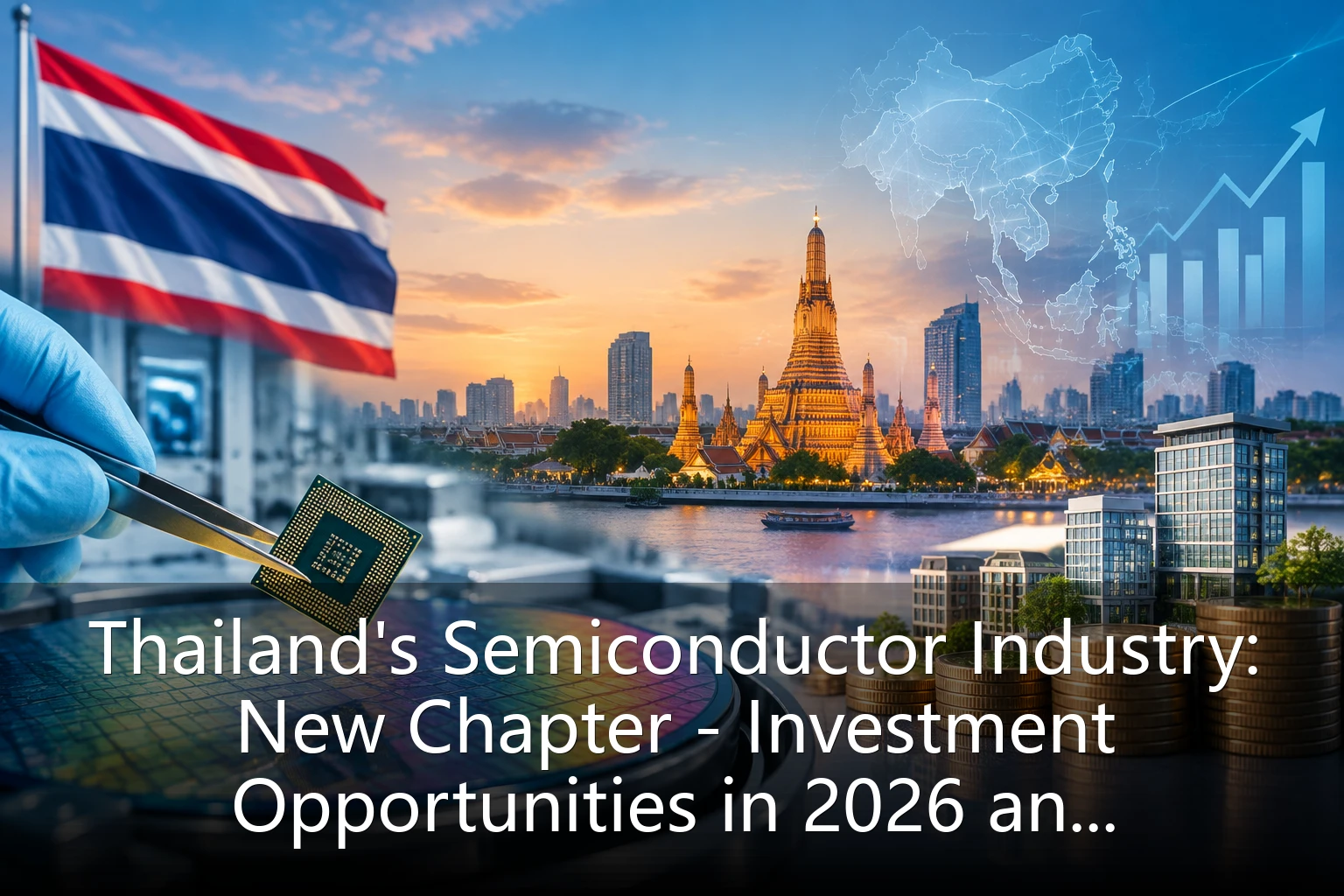
Thailand's semiconductor industry has made significant progress in recent years, becoming one of the important pillars of the national economy. In the first three quarters of 2026, Thailand's semiconductor industry output reached 1500 billion Thai baht, a year-on-year increase of 25%, accounting for 3.2% of GDP.
Policy Support and Industrial Planning
The Thai government highly values the development of the semiconductor industry, listing it as one of the "national strategic industries." In August 2026, Thailand's Ministry of Industry released the "Thailand Semiconductor Industry Development Roadmap (2026-2030)", clarifying the development goals and policy measures for the next five years. The main contents include:
- Establishing a 5 billion Thai baht semiconductor industry development fund to support enterprise R&D and innovation
- Providing tax incentives, including corporate income tax reductions, import equipment tariff reductions, etc.
- Strengthening talent cultivation, cooperating with domestic and foreign universities to establish semiconductor majors
- Improving infrastructure construction, especially for electricity, water resources and other needs required by the semiconductor industry
Investment Environment and Industrial Clusters
Thailand has formed several semiconductor industry clusters, with the most prominent being the Eastern Economic Corridor (EEC) area. This region has attracted a large number of international semiconductor enterprise investments, including global giants such as TSMC, Intel, and Samsung.
As of September 2026, Thailand has attracted more than 20 billion US dollars in foreign investment related to semiconductors, establishing a complete industry chain including wafer manufacturing, packaging and testing, and equipment manufacturing. Especially in the advanced packaging field, Thailand has become the world's third largest production base, second only to mainland China and Taiwan.
Technological Innovation and Industrial Upgrading
Thailand's semiconductor industry is extending from traditional packaging and testing to high-value-added segments. In 2026, several Thai local enterprises began to enter the fields of chip design and wafer manufacturing, breaking the previous situation of being mainly concentrated in the backend. For example, Thailand Semiconductor Company (TSC) successfully developed a 7-nanometer process chip, marking a new level for Thailand's semiconductor industry technology.
The Relationship Between the Semiconductor Industry and REITs
The development of the semiconductor industry is closely related to the Real Estate Investment Trust (REIT) market. On one hand, the semiconductor industry requires a large amount of infrastructure such as factories and R&D centers; on the other hand, REITs, as an investment tool, provide investment channels for real estate related to the semiconductor industry chain.
Demand for Real Estate from the Semiconductor Industry
The demand for real estate from the semiconductor industry is mainly reflected in the following aspects:
- Production facilities: Wafer fabs, packaging and testing plants require large areas of industrial land and factories
- R&D centers: Chip design and R&D require modern office and laboratory space
- Supporting facilities: Employee dormitories, commercial supporting facilities and other living service facilities
- Logistics and warehousing: Storage and transportation of raw materials and products require professional logistics facilities
Development of Thailand's Semiconductor REIT Market
With the rapid development of Thailand's semiconductor industry, the related REIT market is also showing vigorous development momentum. As of September 2026, Thailand has 5 REITs focused on real estate related to the semiconductor industry, with a total market value exceeding 80 billion Thai baht.
These REITs mainly invest in semiconductor industrial parks, R&D centers, supporting commercial facilities, etc., providing investors with opportunities to participate in the development of the semiconductor industry. For example, Thailand Semiconductor Industry REIT (TSREIT) mainly invests in semiconductor industrial parks in the Eastern Economic Corridor, with a return rate of 12.3% since 2026, showing excellent performance.
Investment Opportunity Analysis
Semiconductor Industry Chain Investment Opportunities
Investment opportunities in the Southeast Asian semiconductor industry chain are mainly concentrated in the following aspects:
- Upstream segments: Semiconductor materials, equipment manufacturing and other fields still have large development space
- Midstream segments: Technology-intensive segments such as wafer manufacturing and advanced packaging have high added value
- Downstream segments: Chip demand in application fields such as automotive electronics, IoT, and AI is growing rapidly
- Supporting services: Supporting services such as design services, testing and certification, and logistics have strong demand
REIT Investment Opportunities
In the REIT field, the following investment opportunities are worth noting:
- Professional semiconductor industrial park REITs: REITs focused on the development of semiconductor industrial parks, such as TSREIT
- R&D center REITs: REITs investing in high-tech R&D centers, enjoying stable rental income
- Supporting commercial facility REITs: REITs investing in commercial facilities around semiconductor industrial parks, benefiting from industrial agglomeration effects
- Logistics facility REITs: Logistics and warehousing facility REITs serving the semiconductor industry
Regional Investment Comparison
Among Southeast Asian countries, Thailand's semiconductor industry investment environment has the following advantages:
- Strong policy support and clear industrial planning
- Complete infrastructure and convenient transportation
- Relatively abundant talent reserves and complete education system
- Stable political environment and sound legal system
- Mature REIT market and complete exit mechanism
Risks and Challenges
Although the Southeast Asian semiconductor industry has broad prospects, investors still need to pay attention to the following risk factors:
- Technical barriers: The semiconductor industry has a high technical threshold, and core technologies are still mastered by a few countries
- Market competition: Countries in the region are competing to develop the semiconductor industry, and competition is becoming increasingly fierce
- Supply chain risks: Global supply chain restructuring may bring uncertainties
- Policy changes: Adjustments in industrial policies of various countries may affect the investment environment
- Geopolitics: Changes in international relations may affect industrial cooperation
Future Outlook
Looking forward to the fourth quarter of 2026 and beyond, the Southeast Asian semiconductor industry will show the following development trends:
- Accelerated technology upgrading: Advanced packaging, third-generation semiconductor technologies and other technologies will be accelerated in application
- Industry chain integration: The regional industry chain will become closer, forming synergies
- Green and low-carbon: The semiconductor industry will pay more attention to environmental protection and sustainable development
- Digital transformation: Smart manufacturing, digital twin and other technologies will be deeply applied
- REIT innovation: More innovative REIT products targeting the semiconductor industry will emerge
For investors, seizing the development opportunities of the Southeast Asian semiconductor industry, especially participating in the related industry chain through REITs, will bring long-term stable returns.
Conclusion
The Southeast Asian semiconductor industry is in a stage of rapid development. As a regional leader, Thailand is gradually building a complete semiconductor industry chain through policy support, technological innovation, and industrial upgrading. For investors, paying attention to Thailand and the Southeast Asian semiconductor industry, especially participating in the related industry chain through REITs, will be a worthy investment direction.
In the investment process, investors are advised to pay attention to the following aspects: first, grasp the development trends of various links in the industry chain; second, choose high-quality REIT products; third, pay attention to policy changes and technological progress; fourth, do a good job of risk management and asset allocation. Through rational analysis and long-term layout, investors are expected to obtain generous returns in the wave of the Southeast Asian semiconductor industry.