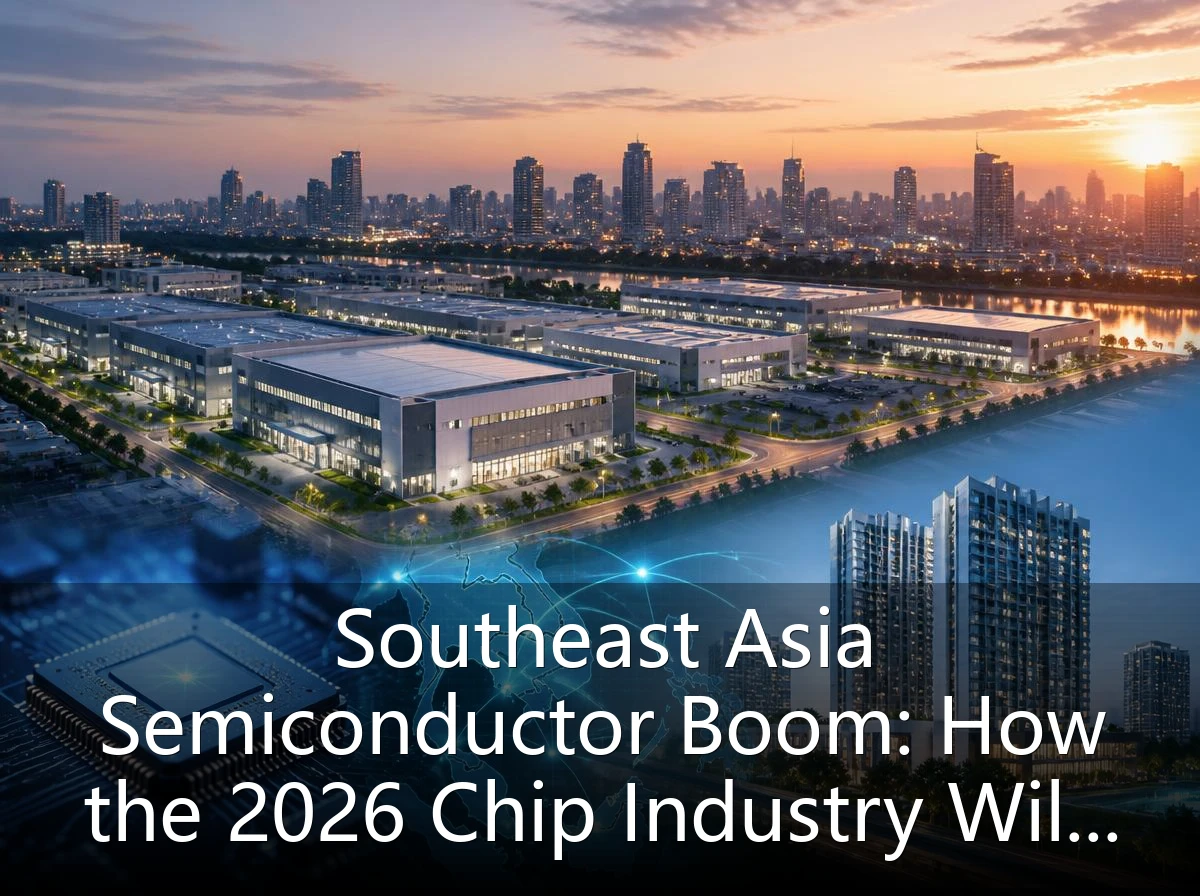

In the third quarter of 2026, the Southeast Asian semiconductor market has reached a historic turning point. As the global chip supply chain continues to restructure, Thailand is rapidly emerging as a new engine for the Southeast Asian semiconductor industry, leveraging policy dividends and industrial clustering effects. This trend has not only changed the regional semiconductor market landscape but has also had a profound impact on the Asia-Pacific Real Estate Investment Trust (REITs) market, bringing entirely new opportunities and challenges to investors.
\n\nThailand's Semiconductor Industry: From Follower to Regional Leader
\n\nIn recent years, Thailand's semiconductor industry has experienced unprecedented rapid development. According to the latest data from the Thailand Board of Investment (BOI), foreign investment applications in Thailand's semiconductor sector reached $26.8 billion in the first three quarters of 2026, a historic high. This figure represents a nearly 65% increase compared to the same period in 2025, indicating that Thailand is gradually becoming a popular destination for global semiconductor investment.
\n\nThe rise of Thailand's semiconductor industry is no accident. Since the launch of the "Thailand 4.0" strategy in 2023, the government has actively attracted international semiconductor giants through a series of tax incentives, land subsidies, and talent introduction policies. Currently, leading global chip companies such as Intel, TSMC, and Samsung have all announced expanded investments in Thailand, with several enterprises already beginning construction of 12-inch wafer fabs, marking a new stage for Thailand's semiconductor industry.
\n\nDual Drivers of Policy Dividends and Industrial Clustering
\n\nThe rapid development of Thailand's semiconductor industry is mainly due to two key factors: policy dividends and industrial clustering effects. At the policy level, the Thai government's "Eastern Economic Corridor (EEC)" plan has established a "Special Semiconductor Incentive," offering enterprises investment tax exemptions of up to 8 years, with preferential rates of up to 90% tax exemption. Additionally, the government has promised comprehensive infrastructure support, including power supply, water resource management, and logistics networks.
\n\nIn terms of industrial clustering, Thailand has formed semiconductor industry clusters centered around Bangkok, Chonburi Province, and Rayong Province. These regions not only have advantageous geographical locations near major ports and international airports but also have complete supply chain support and abundant talent resources. Statistics show that Thailand's semiconductor industrial parks have attracted more than 50 chip-related enterprises, forming a complete industrial chain from design, manufacturing to packaging and testing.
\n\nNew Landscape of Southeast Asian Semiconductor Market: Thailand Leading Regional Transformation
\n\nWith the rapid rise of Thailand's semiconductor industry, the Southeast Asian regional semiconductor market landscape is undergoing profound changes. For a long time, Malaysia and Singapore have been the dual powers of the Southeast Asian semiconductor industry, but Thailand is rapidly narrowing the gap with its latecomer advantages, and even surpassing in certain areas.
\n\nData from the third quarter of 2026 shows that Thailand's semiconductor exports increased by 78% year-on-year, reaching a record $15.6 billion, accounting for 27% of Southeast Asia's total semiconductor exports, up from 15% in 2022. This growth rate not only far exceeds that of Malaysia and Singapore but also makes Thailand the fastest-growing country in Southeast Asia in terms of semiconductor exports.
\n\nRegional Supply Chain Restructuring and Thailand's Changing Role
\n\nThe restructuring of the global semiconductor supply chain is an important background for Thailand's rise. As geopolitical tensions and trade friction intensify, countries are seeking supply chain diversification to reduce dependence on single regions. Against this backdrop, Southeast Asia, with its geographical advantages, labor costs, and policy support, has become an important destination for global semiconductor supply chain transfer.
\n\nIn the process of regional supply chain restructuring, Thailand is transforming from a traditional "backend packaging and testing base" to a "full industrial chain layout." Currently, Thailand is no longer limited to chip packaging and testing but is actively developing high-value-added segments such as chip design, wafer manufacturing, and advanced packaging. This transformation has significantly enhanced Thailand's position in the regional semiconductor supply chain, changing from a "follower" to a "leader."
\n\nImpact of Semiconductor Industry Rise on Asia-Pacific REITs Market
\n\nAs a professional investment research platform specializing in Thailand and Asia-Pacific REITs, Terre Global Investment Research has observed that the rise of the semiconductor industry is profoundly impacting the Asia-Pacific Real Estate Investment Trust (REITs) market. This impact is not only reflected in the increased value of commercial real estate around semiconductor industrial parks but also in the restructuring of the entire regional real estate investment logic.
\n\nREITs Around Industrial Parks Benefit Significantly
\n\nWith the rapid development of semiconductor industrial parks, the value of surrounding commercial real estate has significantly increased. Data shows that in the first three quarters of 2026, industrial real estate prices in Chonburi Province and Rayong Province around Bangkok, Thailand, increased by an average of 35%, far higher than the national average. This trend has directly driven the performance of related regional REITs, with Thailand's industrial real estate REIT index rising by 42% this year, outperforming the market index by nearly 20 percentage points.
\n\nIn addition to industrial real estate REITs that directly benefit from semiconductor industrial park development, logistics real estate REITs related to the semiconductor industry have also performed impressively. With the improvement of the semiconductor industry chain, related logistics demand has surged, driving up logistics real estate rents and reducing vacancy rates. Data shows that the average vacancy rate of Thailand's logistics REITs has fallen to a historic low of 3.2%, with average rents increasing by 18% year-on-year.
\n\nSemiconductor Industry REITs: Emerging Investment Category
\n\nBeyond traditional industrial and logistics REITs, a new type of semiconductor industry REIT is emerging in the Asia-Pacific region. These REITs specialize in investing in semiconductor industrial parks, R&D centers, and supporting facilities, providing investors with channels to participate in the development of the semiconductor industry. In 2026, Thailand successfully launched its first semiconductor industry REIT, raising $1.5 billion with an oversubscription multiple of 3.5 times, showing strong market demand for such products.
\n\nThe rise of semiconductor industry REITs reflects investors' optimistic attitude toward the long-term prospects of the semiconductor industry. Compared to traditional REITs, these REITs have higher growth potential and anti-cyclicality. With the continuous development of the semiconductor industry, semiconductor industry REITs are expected to become an important part of the Asia-Pacific REITs market.
\n\nInvestment Opportunities and Risk Analysis
\n\nThe rise of the semiconductor industry has brought abundant investment opportunities to the Asia-Pacific REITs market, but it is also accompanied by certain risks. Investors need to comprehensively evaluate these opportunities and risks to make rational investment decisions.
\n\nInvestment Opportunities: Three Growth Engines
\n\nFirst, commercial real estate REITs around semiconductor industrial parks have significant growth potential. With the expansion of semiconductor industrial parks, the demand for surrounding infrastructure and commercial supporting facilities will continue to grow, driving up the value of related real estate. This growth trend is particularly evident in semiconductor industry clusters such as Chonburi Province and Rayong Province in Thailand.
\n\nSecond, logistics REITs related to the semiconductor industry also have good investment value. The improvement of the semiconductor industry chain requires efficient logistics support, providing stable rental income and growth space for logistics real estate REITs. This is particularly true for high-precision logistics demand in advanced packaging and testing segments.
\n\nThird, semiconductor industry REITs, as an emerging investment category, provide investors with opportunities to participate in the development of the semiconductor industry. These REITs typically establish strategic partnerships with leading semiconductor enterprises and research institutions, enabling them to share the dividends of semiconductor industry development. With the continuous innovation of the semiconductor industry, these REITs are expected to achieve excess returns.
\n\nRisk Factors: Three Challenges to Be Alert To
\n\nAlthough semiconductor industry REITs have many investment opportunities, investors also need to be alert to potential risks. First, the semiconductor industry is highly cyclical, and when the industry enters a downturn, demand for related industrial parks and commercial real estate may be affected, thereby affecting REIT performance.
\n\nSecond, the semiconductor industry has rapid technological updates and replacements, and the uncertainty of technology routes may lead to a decline in investment value in certain segments. Investors need to pay attention to technological development trends and avoid investing in technology routes that may be eliminated.
\n\nFinally, policy changes are also an important factor affecting semiconductor industry REITs. Adjustments in government policy support, tax incentives, and other policies for the semiconductor industry may all affect the performance of related REITs. Investors need to closely monitor policy changes and adjust investment strategies in a timely manner.
\n\nFuture Trends: Deep Integration of Semiconductors and REITs
\n\nLooking ahead, the integration of the semiconductor industry and the Asia-Pacific REITs market will become more profound. With the continuous development and innovation of the semiconductor industry, more investment products related to the semiconductor industry will appear in the REITs market, providing investors with diversified investment choices.
\n\nInnovative REITs Driven by Innovation
\n\nIn the future, with the continuous advancement of semiconductor technology, more innovative semiconductor industry REITs may emerge. For example, REITs specializing in semiconductor R&D facilities, semiconductor industry incubators, and semiconductor industry digital infrastructure. These new types of REITs will provide investors with more opportunities to participate in the innovative development of the semiconductor industry.
\n\nIn addition, with the integration of the semiconductor industry and other emerging technologies such as artificial intelligence, Internet of Things, and 5G, cross-industry REIT products may emerge, such as "Semiconductor + AI" REITs and "Semiconductor + IoT" REITs. These products will benefit from the synergistic development of multiple industries and have higher growth potential.
\n\nRegional Coordination and Cross-Border Investment
\n\nIn the future, the coordinated development of the semiconductor industry in Southeast Asia will further strengthen, which will promote interconnection within the regional REITs market. With the deep integration of semiconductor industry chains among ASEAN countries, cross-border REIT investment will become more active, providing investors with more regional investment opportunities.
\n\nEspecially among major Southeast Asian semiconductor industry countries such as Thailand, Malaysia, and Vietnam, the linkage of REITs markets will strengthen. Investors can diversify regional risks and obtain more stable returns through cross-border REIT investment.
\n\nConclusion: Seizing New REIT Investment Opportunities in the Semiconductor Era
\n\nIn the third quarter of 2026, the Southeast Asian semiconductor market has reached a historic turning point, with Thailand rapidly emerging as a new engine for the regional semiconductor industry. This trend is reshaping the Asia-Pacific real estate investment trust market landscape, bringing entirely new opportunities and challenges to investors.
\n\nFor investors, the rise of the semiconductor industry is both an opportunity and a challenge. On one hand, commercial real estate REITs around semiconductor industrial parks, logistics REITs related to the semiconductor industry, and emerging semiconductor industry REITs all have good investment value; on the other hand, factors such as the cyclical nature of the semiconductor industry, technological uncertainty, and policy changes also require investors' vigilance.
\n\nIn the future, with the deep integration of the semiconductor industry and the REITs market, investors need to pay more attention to the development trends of the semiconductor industry, seize investment opportunities, and avoid potential risks. Especially in regions with rapid development of the semiconductor industry such as Southeast Asia, the REITs market will see more structural opportunities worthy of investors' attention.
\n\nIn conclusion, REIT investment in the semiconductor era is embracing new changes and opportunities. Investors need to adopt a more open and forward-looking perspective, grasp the trend of integrated development between the semiconductor industry and the REITs market, and share the dividends of semiconductor industry development under the premise of controllable risks.