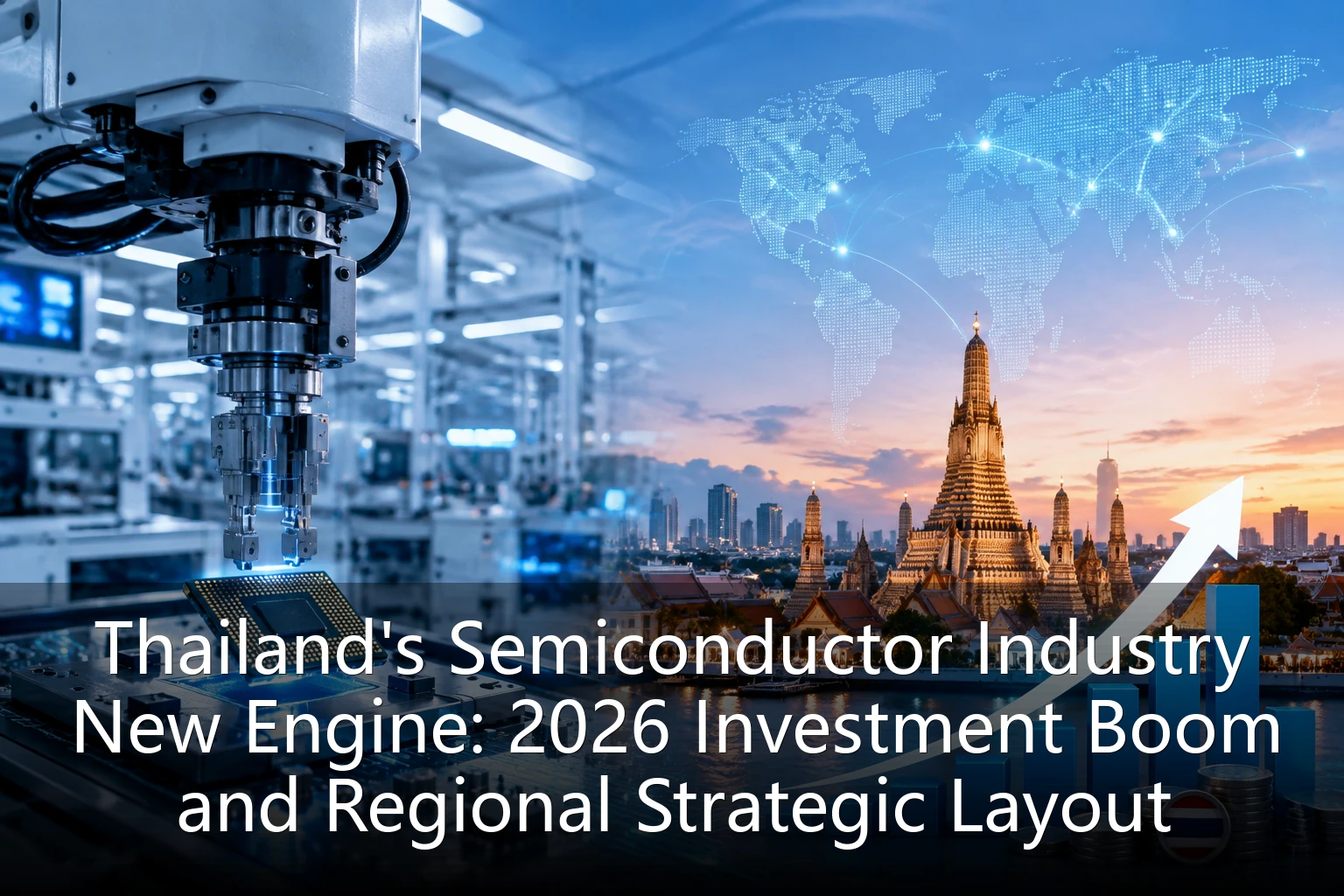
Thailand's Semiconductor Industry New Engine: 2026 Investment Boom and Regional Strategic Layout
The Southeast Asian semiconductor industry landscape in 2026 is undergoing profound changes, with Thailand rapidly emerging as a new engine for the Asia-Pacific semiconductor industry by leveraging its unique geographical advantages, policy support, and industrial foundation. According to the latest data, Thailand's semiconductor industry investment has exceeded $13.4 billion in the first half of 2026, a 42% year-on-year increase, reaching a historic high. This investment boom is not only reshaping Thailand's industrial structure but also having a profound impact on the Asia-Pacific real estate trust market, bringing unprecedented opportunities and challenges to investors.
Strategic Background of Thailand's Semiconductor Industry Rise
The rapid development of Thailand's semiconductor industry is not accidental but the result of multiple factors working together. Firstly, the global context of semiconductor supply chain restructuring has provided a historic opportunity for Thailand. With changes in the geopolitical landscape, countries are seeking supply chain diversification, and Thailand, with its geographical advantages and political stability, has become the preferred destination for multinational semiconductor companies to establish a presence in Southeast Asia.
Secondly, Thailand's "Thailand 4.0" strategy and Eastern Economic Corridor (EEC) development plan in recent years have provided strong policy support for the semiconductor industry. The government has not only offered incentives in terms of tax benefits and land supply but also established special industry funds to attract domestic and foreign capital to invest in various links of the semiconductor industry chain.
In addition, Thailand's existing electronic manufacturing foundation has provided a solid foundation for the development of the semiconductor industry. For a long time, Thailand has been an important global electronics production base, with complete supporting industries and skilled technical workers, creating favorable conditions for the establishment and development of the semiconductor industry.
Main Driving Factors of the 2026 Investment Boom
An in-depth analysis of the investment boom in Thailand's semiconductor industry reveals several key driving factors:
- Continuously Growing Global Chip Demand: With the rapid development of emerging technologies such as artificial intelligence, 5G communication, and the Internet of Things, global chip demand continues to rise. Especially in fields such as automotive electronics, industrial control, and consumer electronics, the demand for high-performance chips is showing explosive growth, providing broad market space for Thailand's semiconductor industry.
- Accelerating Regional Industrial Transfer: In recent years, with rising costs and policy adjustments in traditional semiconductor production areas like China, some semiconductor capacity is shifting to Southeast Asia. Thailand, with its relatively stable political environment, complete infrastructure, and lower production costs, has become an ideal destination to undertake this industrial transfer.
- Strategic Layout of Multinational Enterprises: Global semiconductor giants are increasing their investment in Thailand. For example, TSMC is building an advanced packaging and testing base near Bangkok, Samsung is expanding its wafer factory in Chonburi Province, and Intel has established a research center in Thailand. These investments from multinational companies have not only brought capital but more importantly, advanced technology and management experience.
- Rise of Local Enterprises: In addition to multinational investments, Thailand's local semiconductor companies are also growing rapidly. These companies, with their deep understanding of the local market and flexible business strategies, have made breakthroughs in specific niche areas, becoming an important force driving industrial development.
Spatial Layout and Cluster Effect of Thailand's Semiconductor Industry
The layout of Thailand's semiconductor industry shows obvious clustering characteristics, mainly concentrated in the Eastern Economic Corridor (EEC) region, including Chonburi Province, Rayong Province, and surrounding areas of Bangkok. This region has formed a significant cluster effect with its superior geographical location, complete infrastructure, and concentrated industrial support.
The industrial zones in Chonburi Province and the high-tech industrial parks in Rayong Province are the core gathering areas for Thailand's semiconductor industry. These parks have not only attracted semiconductor manufacturing companies but also a large number of supporting enterprises, such as material suppliers, equipment manufacturers, packaging and testing companies, forming a complete industrial chain. According to statistics, the EEC region has now gathered more than 50 semiconductor-related enterprises, with over 100,000 employees.
Notably, the cluster effect of Thailand's semiconductor industry is gradually extending from the manufacturing sector to the R&D and design sector. In recent years, many international semiconductor companies have established R&D centers in Thailand to carry out cutting-edge technology research and development. This upgrade from manufacturing to R&D indicates that Thailand's semiconductor industry is moving toward the high end of the value chain.
Impact of the Investment Boom on Thailand's Real Estate Market
The investment boom in the semiconductor industry has had a profound impact on Thailand's real estate market, especially in the industrial and commercial real estate sectors. With the expansion of semiconductor companies, the demand for supporting facilities such as industrial plants, R&D centers, and employee dormitories has increased significantly, driving the prosperity of related real estate markets.
In terms of industrial real estate, industrial property rents in the EEC region have increased by 15%-20% in the past year, with vacancy rates reaching historic lows. Many semiconductor companies choose to purchase rather than lease industrial land, further pushing up industrial land prices. According to market analysis, industrial land prices in the EEC region have risen by about 30% in the past two years.
In terms of commercial real estate, the concentration of the semiconductor industry has driven the development of surrounding commercial facilities. The demand for office, retail, hotel and other formats continues to grow, and commercial real estate rents are steadily rising. Especially in the commercial areas of Bangkok and Chonburi Province, the rent of high-quality office buildings has reached or even exceeded the level of Bangkok's central business district.
In addition, the development of the semiconductor industry has also driven demand in the residential market. With the increase of semiconductor company employees, the demand for high-quality housing continues to grow, especially in areas surrounding industrial parks. This trend has not only driven up housing prices but also promoted the improvement of surrounding community supporting facilities.
Linkage Effect Between Semiconductor Industry and Real Estate Trust Market
The vigorous development of the semiconductor industry has brought new opportunities to Thailand's real estate investment trust (REITs) market. The stable cash flow and long-term leases of semiconductor industrial parks have become high-quality choices for REITs assets. In recent years, many Thai REITs companies have included properties from semiconductor industrial parks in their investment portfolios to obtain stable returns.
Data shows that in the first half of 2026, the investment amount in semiconductor-related properties in Thailand's REITs market reached approximately $2.8 billion, accounting for 35% of the total investment in industrial real estate REITs, a 60% year-on-year increase. This growth trend is expected to continue, and as more semiconductor industrial parks are built and put into use, related REITs assets will further increase.
Notably, the linkage effect between the semiconductor industry and the real estate trust market is expanding from traditional industrial parks to R&D parks. As the semiconductor industry chain extends to the high end, the demand for R&D facilities is increasing, and R&D park REITs have become a new investment hotspot. These REITs usually have higher rental returns and longer lease terms, making them favored by investors.
Investment Risks and Challenges
Although the investment boom in Thailand's semiconductor industry has brought many opportunities, investors also face risks and challenges that cannot be ignored:
- Talent Shortage: With industrial upgrading and increasing technical complexity, Thailand's semiconductor industry faces a serious talent shortage problem. Especially in high-end chip design and advanced manufacturing processes, professional talent is particularly scarce. This problem not only restricts the development of the industry but also affects the long-term value of related real estate projects.
- Infrastructure Pressure: The semiconductor industry has extremely high requirements for infrastructure, including stable power supply, complete transportation networks, and efficient logistics systems. Currently, the infrastructure construction in the EEC region still has certain lag and cannot fully meet the development needs of the semiconductor industry, which may affect the operational efficiency of related real estate projects.
- Intensifying International Competition: In addition to Thailand, Southeast Asian countries such as Vietnam and Malaysia are also actively developing the semiconductor industry, and competition in policy support, investment environment and other aspects is becoming increasingly fierce. This international competition may affect the attractiveness and development speed of Thailand's semiconductor industry, thereby affecting the performance of related real estate markets.
- Market Volatility Risk: The semiconductor industry has obvious cyclical characteristics and large market fluctuations. With changes in the global economic situation, semiconductor demand may fluctuate, affecting the expansion plans and real estate demand of related companies, bringing uncertainty to REITs investors.
Future Outlook and Investment Strategy Recommendations
Looking ahead, Thailand's semiconductor industry is expected to maintain a growth momentum, but the growth rate may gradually slow down. It is expected that by 2027, Thailand's semiconductor industry investment will reach about $20 billion annually, and the industry size will double. This growth will provide continuous support for related real estate markets and REITs markets.
For investors, the following strategies are worth paying attention to:
- Focus on High-End Links of the Industry Chain: With industrial upgrading, the demand for real estate in high-end links such as R&D design and advanced packaging and testing will grow rapidly. Investors should focus on real estate opportunities in these fields, especially properties related to R&D centers and innovation parks.
- Long-Term Holding Strategy: The semiconductor industry has long-term growth potential, and related real estate projects are also suitable for long-term holding. Investors should avoid short-term speculation and adopt a long-term holding strategy to obtain stable rental income and asset appreciation.
- Diversify Investment Risks: Although the semiconductor industry has good prospects, investors still need to pay attention to diversifying investment risks and avoid over-concentration in a single region or single type of property. Through diversified investment portfolios, reduce risks brought by market fluctuations.
- Pay Attention to Policy Trends: The Thai government's support policies for the semiconductor industry are important factors driving industrial development. Investors should closely follow policy changes, adjust investment strategies in a timely manner, and seize the opportunities brought by policy dividends.
In summary, the investment boom in Thailand's semiconductor industry is reshaping the industrial landscape and real estate market in the Asia-Pacific region, providing rich opportunities for investors. However, facing challenges such as talent shortages, infrastructure pressure, and intensifying international competition, investors need to remain rational and adopt scientific investment strategies to achieve long-term stable returns in this wave of industrial development.