
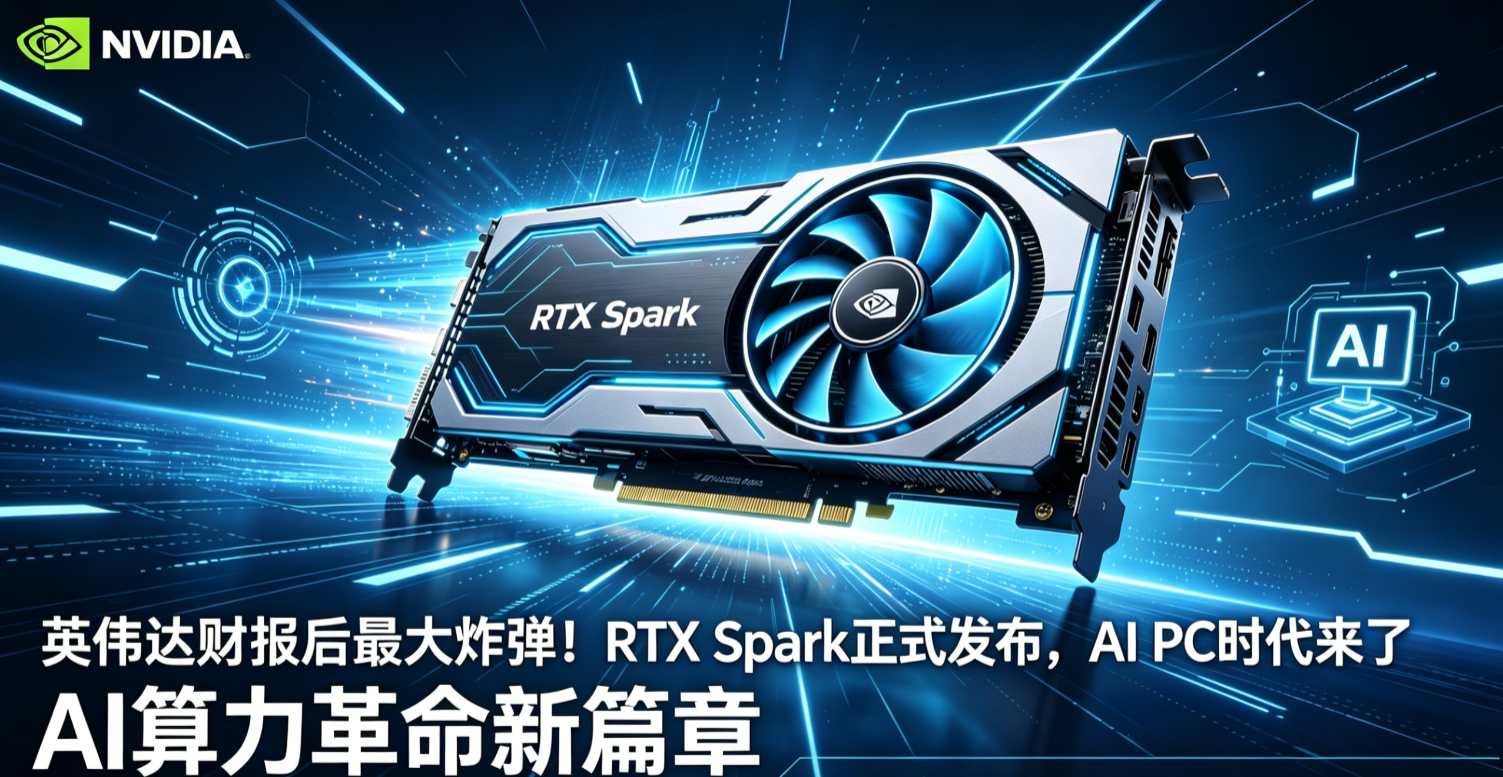
NVIDIA's biggest post-earnings bomb! RTX Spark officially launched, AI PC era is here
Yesterday NVIDIA just released earnings, stock surged 6%! The entire market is boiling, everyone is shouting that AI is still running wild. But this rise is not enough—Jensen Huang at the Computex conference directly dropped an even bigger bomb: the new RTX Spark super PC chip, officially cramming monster-level AI computing power into the laptops and desktops that ordinary people use every day! At the same time, he made a super bold prediction: Physical AI will be worth tens of trillions of dollars in the future, and robots will fully explode within five years!
At the same time, Google parent company Alphabet made a rare $80 billion secondary offering to invest heavily in AI infrastructure, and Buffett's Berkshire Hathaway directly invested $1 billion in cash to subscribe! On the Chinese side, the Southern Fund's STAR Chipline ETF also opened higher and strengthened, surging 1.42% with a single-day net inflow of 152 million yuan.
Four words: demand explosion. The data center business is still the absolute main force. The demand for AI training and inference computing power shows no signs of slowing down; instead, it is accelerating. Global tech giants continue to place crazy orders in order to run larger models and process massive amounts of data. NVIDIA's gross margin remains at a very high level, fully demonstrating that its pricing power and technology moat are still strengthening without any significant signs of loosening.
But Jensen Huang has never been someone who only focuses on the current quarter's performance. He specifically emphasized during the earnings call that NVIDIA's growth engine is diversifying, no longer relying solely on the data center business. The PC, automotive, robotics, and edge computing sectors are all ramping up simultaneously. This earnings report is actually giving the entire market a long-term reassurance: AI is not a short-term hype, but a super technological cycle that may last for ten years or even longer.
NVIDIA's current market position is somewhat like Apple more than ten years ago—it is not just selling hardware products, but also defining the ecological rules and development standards of the entire industry. The CUDA platform, developed from more than ten years ago to the present, is still the most mainstream choice for global AI developers, almost forming a de facto industry standard. That is why so many competitors spend heavily to catch up, but always fall short by that crucial margin. NVIDIA is not just a chip company; it has become an infrastructure-level existence in the AI era.
From a longer historical perspective, NVIDIA has steadily transformed from a company making gaming graphics cards to a leader in AI computing. Every time the market questions its high valuation, it responds with actual performance and new technologies. This earnings report once again proves this point.
RTX Spark super chip—AI truly enters ordinary people's lives. High-end servers in data centers are not enough. This time, Jensen Huang personally released the RTX Spark super chip (also internally called the N1X series) at the Computex keynote. This is the first time NVIDIA has brought such powerful AI computing power to the PC market that ordinary consumers use every day on a large scale, and this step is of great significance.
CPU: 20-core Grace ARM architecture processor, deeply collaborated with MediaTek, achieving excellent performance and power balance, very suitable for devices like laptops that require high battery life. GPU: 6144 CUDA cores, graphics rendering performance close to the mobile version of RTX 5070, while supporting the latest real-time ray tracing and DLSS 4 intelligent frame generation technology, capable for both gaming and creation. Memory system: Supports up to 128GB unified memory (LPDDR5X), with CPU and GPU sharing the same memory, greatly reducing the loss of data transfer back and forth, significantly improving overall efficiency. Process technology: Uses TSMC's most advanced 3nm process, with transistor count reaching 70 billion, extremely high integration, packing in a super amount of stuff. AI computing power peak: 1 PFLOPS, that is, 1 quadrillion floating-point operations per second, which is unprecedented monster-level performance in the laptop category!
The most critical and eye-catching part is that it deeply integrates CPU and GPU through NVLink high-speed interconnect technology, supporting local
efficient running of large language models and personal AI agents with 70B or even larger parameters. In the future, even if your laptop is completely offline, it can independently complete many things that previously had to rely on the cloud:
Automatically edit 4K or even higher resolution videos, intelligently recognize scenes, add subtitles, music, and transition effects Real-time generation of complex code, automatic debugging of bugs, optimization of program performance
While playing large 3A games, intelligently dynamically optimize image quality, frame rate, and lighting effects Run a personal AI assistant locally, quickly process documents, analyze photos, generate creative proposals, and even simulate simple physics experiments
Jensen Huang smiled and said an impressive sentence at the press conference: "We have condensed everything we have learned in the past 33 years into this single chip."
The first batch of new laptops equipped with the RTX Spark super chip has attracted many first-tier manufacturers such as ASUS, Dell, Lenovo, Microsoft Surface, and MSI, and will be launched to the market this autumn. According to demo videos, the new machine can stably maintain over 100 frames per second at 1440p resolution while running Forza Horizon 6 on battery power alone, which directly maximizes appeal for gamers, video creators, and 3D designers.
This event marks that the AI PC era is moving from conceptual hype to true large-scale implementation. Previously, AI applications mainly relied on cloud servers; now local devices can run efficiently, which means lower latency, better privacy protection, and more controllable usage costs. This will bring very direct and significant help to ordinary office workers quickly completing work reports, students' assisted learning and thesis writing, and freelancers improving creative efficiency.
At the same time, this also has a strong catalytic effect on the entire global PC industry chain. As the world's largest PC manufacturing base and consumer market, China will be the first to enjoy the industrial dividends brought by this round of hardware replacement cycle. This is also one of the reasons why the Southern STAR Chipline ETF saw significant increases and capital inflows after the news.
Physical AI is NVIDIA's real trillion-dollar long-term killer move. If RTX Spark is a bright spot that the current market can quickly see, then the big story that Jensen Huang is truly betting on long-term and that the market has the highest hopes for is actually Physical AI.
In other words, Physical AI is not the AI we are familiar with that can only chat, write articles, and generate images; it is a kind of embodied intelligence that truly understands the laws of the physical world, can operate hands-on, and interact with the real world. It needs to deeply understand physical principles such as friction, gravity, inertia, object persistence, and causality, and ultimately be applied on a large scale in real physical scenarios such as humanoid robots, smart factories, autonomous driving cars, drone swarms, and smart logistics.
The prediction Jensen Huang made this time is very radical and very clear: the total potential market size of the Physical AI track could reach tens of trillions of dollars, of which just the humanoid robot segment alone could contribute a huge space of 40-50 trillion dollars. He believes that within the next five years, robots will move from laboratories to large-scale factory deployment and home applications, gradually becoming part of daily life, just like smartphones did back then.
Why can this market develop to such an astonishing scale? Let's analyze from several dimensions:
First, the global labor shortage problem has reached a very severe level. In the United States, many manufacturing factories have long been unable to recruit enough workers; in Europe and East Asia, aging has led to a continuous reduction in labor supply. China has also entered a stage of rapidly rising labor costs. The biggest advantage of robots is that they can work 24 hours a day without rest, no need for raises, no need for leave, greatly alleviating the contradiction between labor supply and demand.
Second, the application space for industrial and production scenarios is extremely broad. Currently, the total value of new factories being built globally is about $5 trillion. If Physical AI technology is applied to optimize factory design, simulate production processes, and real-time intelligent dispatch of robots, the efficiency of the entire production system is expected to increase by 30% to 50%, bringing huge economic value.
Third, the potential on the consumer and service sides is almost unlimited. Imagine that in the future, ordinary households may have home robots to help with housework, take care of the elderly and children; logistics warehouses achieve fully automatic sorting and transportation; construction sites use robots to carry heavy objects and perform dangerous tasks; hospitals use robots to assist in nursing and deliver medicines... Once these scenarios mature, the selling price of a single robot plus subsequent software subscriptions, service maintenance, data value-added income, etc., will form an astronomical-level market.
NVIDIA has obviously started heavy investment in this direction years in advance and has now formed a relatively complete solution system:
Isaac platform: an operating system and simulation environment dedicated to robot development, allowing developers to efficiently test various complex scenarios. GR00T humanoid robot base model: can generate massive synthetic training data, helping robots quickly learn new actions and skills, greatly shortening the training cycle. Omniverse digital twin platform: can create virtual replicas of factories and equipment, allowing thorough testing and optimization before actual deployment, and has been adopted by multiple industrial giants such as TSMC, Foxconn, and Mercedes-Benz.
What is even smarter and more noteworthy is that the newly released RTX Spark PC chip forms a very perfect technical closed loop with Physical AI. Robot engineers and developers can quickly iterate models and perform local simulation tests on their ordinary laptops, greatly lowering the development threshold and time cost. The data center is responsible for training super large models, while PCs and edge devices are responsible for real-time inference and execution. This cloud-edge-device collaborative architecture is the unique advantage of NVIDIA's ecosystem.
I personally firmly believe that Physical AI is not a distant science fiction, but the next industrial revolution that is gradually happening. 2026 will mainly be a phase of technical verification and small-scale pilot implementation, but by 2027-2028, we are likely to see humanoid robots truly enter mass production and volume release. By then, you may see groups of humanoid robots working together in warehouses, robots helping with housework and chatting with the elderly at home, and robots assisting medical staff in hospitals. Human society's productivity and lifestyle will both undergo a major leap.
Part 4: Global Chain Reaction—How NVIDIA Drives the Entire AI Ecosystem
NVIDIA's strong performance is triggering a global chain reaction and resource reallocation.
Take Google as an example. Why did they choose this time to make a rare equity financing of $80 billion to invest heavily in AI infrastructure, and also attract a $1 billion subscription from Berkshire Hathaway? The fundamental reason is that they need massive, high-performance computing power support, and NVIDIA is currently the most advanced and reliable choice in the industry. Google Cloud's first-quarter revenue grew strongly, and its backlog order scale has approached $460 billion. They must expand infrastructure on a large scale in advance to meet future demand.
This further proves that NVIDIA is no longer just a chip supplier, but the core foundation of the entire AI ecosystem. On the demand side, giants like Google, Microsoft, Meta, and Amazon are frantically increasing AI investment; on the supply side, NVIDIA provides top-notch chips and software platforms; and in the middle, there is China's vast supply chain system and application implementation capabilities. These three forces mutually promote each other and jointly drive the entire industry forward.
Therefore, the Chinese capital market reacted very quickly. The Southern STAR Chipline ETF tracks the STAR Chipline index, with constituent stocks covering multiple links such as chip design, manufacturing, equipment, and materials. Yesterday, it saw a high open and strengthening trend with obvious net capital inflows, reflecting the market's continued attention and confidence in NVIDIA's supply chain and the robot industry chain.
Finally, let's fast-forward the timeline to 2030 and think about what changes might happen in ordinary people's daily lives if these technological trends continue to materialize.
Waking up in the morning, you may no longer need to set an alarm yourself. The home robot will gently wake you up based on your sleep data and the day's schedule. At the same time, it has already prepared a nutritionally balanced breakfast according to your health data and preferences, and tidied up the living room and bedroom.
You go out to work, get into a Robotaxi, and the vehicle automatically adjusts the route and interior space based on real-time traffic, weather, and your personal habits. At the company, the Physical AI-driven digital twin system displays the real-time operating status of the global supply chain, helping you simulate the cost, efficiency, and risk of different decision plans in just seconds. Your RTX Spark second-generation laptop has become a super productivity tool. It can quickly run complex AI models locally, helping you analyze reports, generate creative proposals, and even simulate physics experiment processes, greatly shortening the work time that used to take days. On a more macro industrial level, large numbers of humanoid robots are working with high precision 24/7, taking on repetitive, high-risk, or high-labor-cost positions. The labor shortage problem has been fundamentally alleviated, and the overall social productivity curve has experienced a new round of steep rise.
NVIDIA, from an initial company focused on gaming graphics cards, has gradually grown into the most important infrastructure promoter of the AI era. It not only maintains a leading position in chip hardware, but also defines and promotes the intelligent process of the physical world through software platforms such as CUDA, Isaac, and Omniverse. As the world's manufacturing and consumption giant, China plays an irreplaceable role in improving the supply chain, implementing application scenarios, and optimizing costs. The global AI industry chain is forming a mutually beneficial and complementary pattern.
This transformation from pure digital information intelligence to truly embodied physical intelligence is gradually happening before our eyes. Its profound impact on human society's production methods, lifestyle, and even the entire economic structure may far exceed our current imagination.