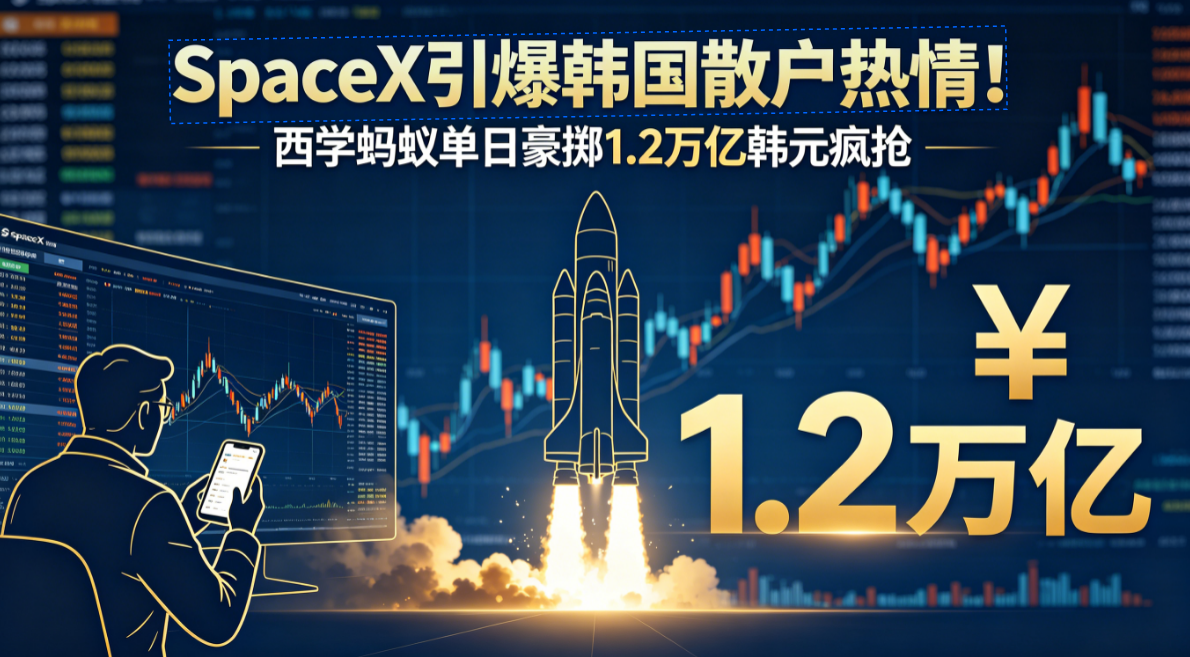
Korean 'Seohak ants' rush to SpaceX: A retail-driven tech faith and market game
Keywords
Seohak ants; SpaceX IPO; South Korean retail investors; Musk concept stocks; single-day net buying record
Introduction: A capital leap into the stars
On June 12, 2024, Musk's space exploration company SpaceX officially landed on NASDAQ, marking not only a milestone in the capitalization of the global space industry but also a collective frenzy among South Korean retail investors. Data shows that on the first trading day, retail investors known as "Seohak ants" net purchased nearly $800 million worth of SpaceX stock, setting a historical record for South Korean investors' single-day overseas stock buying. This figure far exceeds the previous record for the Direxion Daily Semiconductor Bull 3X Shares (SOXL), reflecting the almost religious faith and precise betting strategy of South Korea's small investors in "Musk concept stocks."
I. Phenomenon decoded: Retail power behind the trillion-won single day
The term "Seohak ants" refers to small-scale retail investors in South Korea who are keen on investing in overseas stock markets, especially U.S. stocks. "Seohak" originally meant Western learning, now metaphorically referring to overseas capital markets; "ants" vividly depicts the collective characteristics of small investors aggregating into a large force. According to data from the Korea Securities Depository, SpaceX was priced at $135 per share, opened at $150 on the first day, hit an intraday high of $176, and closed at $161.11, up 19.3% from the IPO price. Based on the closing price, South Korean retail investors bought approximately 4.9 million to 5 million shares that day, with net purchases amounting to $795.93 million (about 1.215 trillion won).
The striking aspect of this figure is its "leapfrog lead" – the previous record for South Korean retail investors' single-day net overseas stock buying was $514.22 million for the Direxion Daily Semiconductor Bull 3X Shares (SOXL), and SpaceX's first-day net buying was nearly 55% higher. In the domestic Korean market, single-day net purchases of a single U.S. stock exceeding 1 trillion won are extremely rare, a phenomenon worthy of being recorded in the history of South Korean private capital flows.
II. Behavioral analysis: The spread of 'Musk faith' driven by technology
SpaceX was not a sudden investment target for South Korean retail investors. As early as one month before the IPO, Korean investors had already net purchased $316.54 million in related assets through tools like the TEMA Space Innovators ETF, indicating an early layout in the commercial space race. This strategy of "pre-IPO ambush and heavy first-day position" aligns with South Korean retail investors' long-standing enthusiasm for Tesla – as of June 11, Tesla remained the largest overseas holding of South Korean retail investors, with a total market value exceeding $24 billion.
From a technical perspective, the decision-making chain of South Korean retail investors includes three key layers:
-
Disintermediated information access: South Korean retail investors commonly use mobile trading platforms (such as Mirae Asset and Samsung Securities' overseas stock apps) to track U.S. stock pre-market trading and short-selling data in real time. Before the SpaceX IPO, discussions on Reddit, Naver Cafe, and other communities about its valuation models, rocket launch success rates, and Starlink revenue projections had been ongoing for months.
-
Proficient use of leverage tools: The Korea Exchange allows retail investors to buy U.S. stocks through "overseas stock financing" with a margin of 40% or more, and some brokerages even offer T+0 trading. This fintech infrastructure enables ant-sized funds to leverage daily trading volumes worth hundreds of millions of dollars.
-
Quantitative extrapolation of the 'Musk effect': The legend of Tesla's stock rising from $35 in 2019 to $1,200 in 2021 (post-stock split) is viewed by South Korean retail investors as a pricing template for "technology disruptors." Using a similar valuation framework – considering SpaceX as "Tesla of space + AI infrastructure company" – they run discounted cash flow models, concluding that the opening price of $150 on the first day had a safety margin.
III. Market shock: The capital logic behind consecutive limit-ups
South Korean retail investors' bet yielded excess returns in the short term. On the second trading day after the IPO (June 15), SpaceX's stock surged 19.6% and rose for three consecutive days. By June 18, the company's market cap reached $2.65 trillion, slightly exceeding Amazon, making it the fifth most valuable listed company globally. This phenomenon of "retail-driven market cap explosion" is extremely rare in mature markets, exposing the structural imbalance in current U.S. stock market liquidity: institutional investors (due to regulatory limits, such as pension funds' cap on unprofitable companies) did not fully participate, while the concentrated inflow of retail funds directly shifted the supply-demand curve.
From a technical perspective, on the first trading day, South Korean retail investors accounted for about 3.7% of SpaceX's trading volume, but since their trades were concentrated in the first 30 minutes and the closing period, they had a significant "anchoring effect" on price discovery. This effect is also observable in other popular NASDAQ stocks held by South Korean retail investors (such as Nvidia and AMD): when South Korea's single-day net buying exceeds a certain threshold, the stock's daily gain is systematically 0.5 to 1 percentage point higher.
IV. Long-term picture: Value reassessment from space adventure to AI infrastructure
South Korean retail investors regard SpaceX as "a long-term bet on AI, satellite infrastructure, and future technologies." This judgment is not merely emotional but based on a quantifiable technology roadmap:
- Starlink has deployed over 6,000 low-earth orbit satellites covering 50 countries, providing broadband services to remote areas, directly generating annual revenue of about $4 billion (2023 data, expected to double by 2025);
- Starship's successful fully reusable rocket tests have reduced launch costs from SpaceX's Falcon 9's $3,000 per kilogram to a target below $300 per kilogram, directly threatening the traditional space launch market;
- AI computing infrastructure: SpaceX plans to use the Starlink network to provide low-latency data transmission for edge computing, and has signed agreements with multiple cloud service providers – viewed as a "hidden option" in its valuation that has yet to be fully priced in.
With 1 trillion won (about 5.3 billion yuan), South Korean retail investors expressed their faith in this "technology-capital" virtuous cycle – their holding behavior is essentially a heavy bet after risk quantification, not blind following. While global institutions were still debating SpaceX's forward P/E ratio, the Korean ants had already cast their votes with real money for the commercial space race.
Conclusion: Ant legions and the new normal of tech capital
The "mass buying spree" by South Korean retail investors on SpaceX's IPO day reveals a new paradigm in global capital flows: in today's world where small investors, through mobile internet, leverage tools, and community collaboration, achieve "collective intelligence," a single country's retail investor group can influence the short-term pricing of trillion-dollar market cap companies. This challenges traditional institution-led pricing models while hiding liquidity risks – if an external shock (e.g., a U.S. stock pullback, regulatory policy changes) triggers mass liquidation, the resulting market turmoil could be more severe than the 2021 GameStop incident.
For South Korean retail investors, investing in SpaceX goes beyond pure financial returns; it is a declaration of technological optimism. As they use the wisdom of Seohak ants to seek new narratives in global capital markets, they may be writing a larger story: how collective action by ordinary investors defines future value benchmarks amid technological revolutions. And the SpaceX stock price K-line is merely the first footnote to this story.