Biomedical output decline drags manufacturing: Feb only down 0.1%
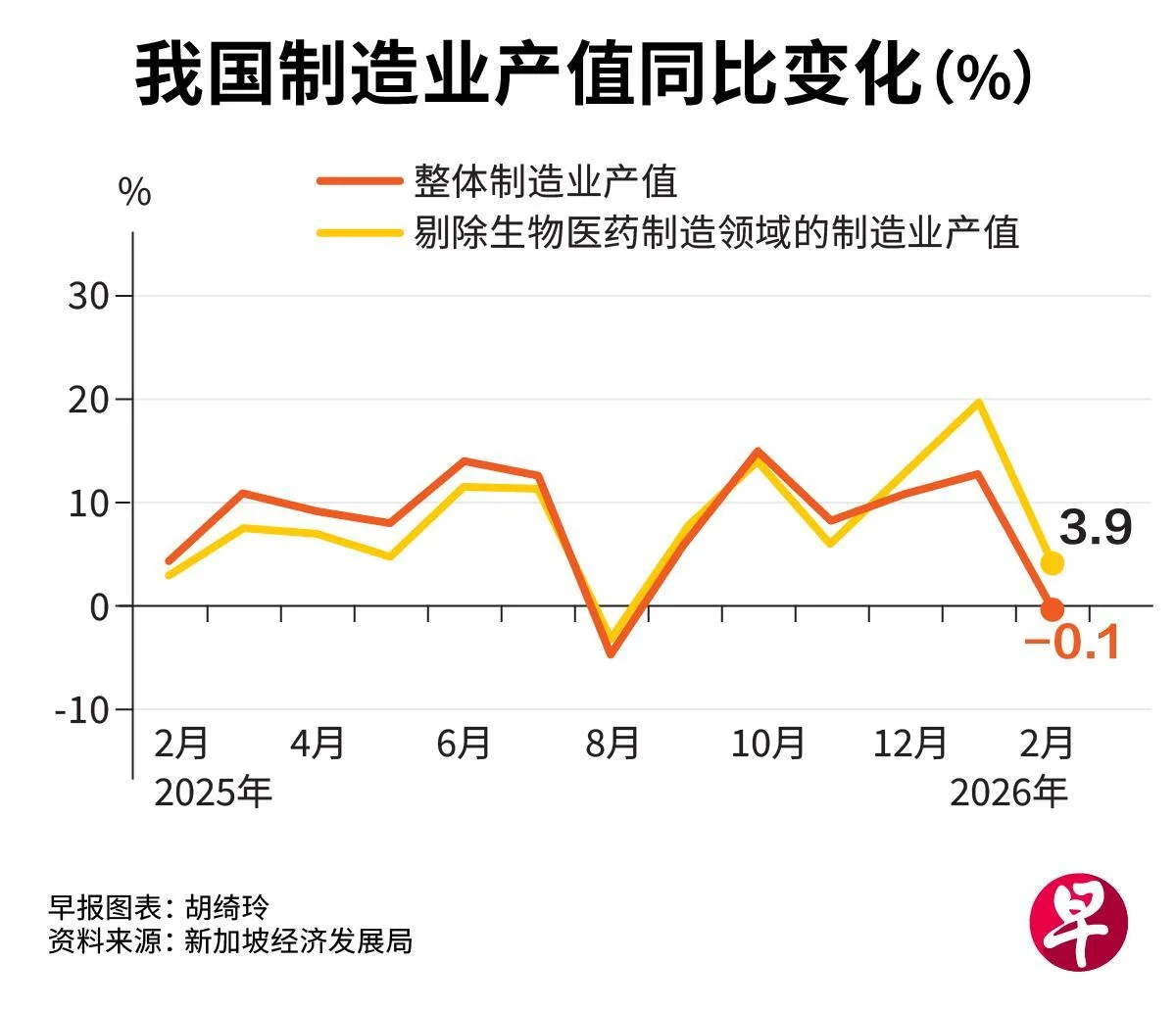
Affected by a sharp decline in biomedical output and a slowdown in production activities during the Lunar New Year, Singapore's February manufacturing output unexpectedly fell 0.1% year-on-year, a significant contrast to Bloomberg economists' forecast of 8.3% to 14.1% growth.
Economists pointed out that if the Middle East war lasts more than three months, Singapore's manufacturing output and overall economic growth will continue to face pressure.
The Singapore Economic Development Board stated in a press release on Thursday (March 26) that excluding biomedical manufacturing, February manufacturing output grew 3.9% year-on-year. Cumulatively for the first two months of this year, manufacturing output rose 6.9% year-on-year.
Seasonally adjusted, February manufacturing output fell 7.2% month-on-month; excluding biomedical manufacturing, output fell 9.4% month-on-month.
Looking at major sectors, electronics grew 13.7% year-on-year, benefiting from increases in information and communications, consumer electronics, and semiconductors; biomedical manufacturing saw the largest decline, down 27.3% year-on-year, mainly due to decreased output in pharmaceuticals and medical technology.
General manufacturing, including food, beverages, and tobacco, fell 5.7% year-on-year. Chemicals and precision engineering fell 4.6% and 3.5% respectively. Transport engineering edged down 0.2%.
In January, driven by strong electronics, Singapore's manufacturing output grew 16.6% year-on-year, higher than December's 10.9% and above Bloomberg economists' median forecast of 12.1%.
Analysis: Middle East conflict pressures economy and production
DBS Bank senior economist Chua Han Teng noted that Singapore's February manufacturing output fell slightly by 0.1%, mainly due to factory closures during the Lunar New Year. He said considering the Lunar New Year impact, manufacturing performance during this period may inevitably be volatile but is expected to rebound in March.
Chua also remains optimistic about the semiconductor sector, as global AI-related demand remains robust, driving up demand for memory chips and server products.
UOB senior economist Lee Ju Ye said in a report on Thursday that although Singapore's economic growth and manufacturing activities are still supported by the AI sector early this year, if the Middle East war lasts more than three months, the economy will face downside risks, with manufacturing, wholesale trade, transport and storage likely bearing the brunt.
Lee forecasts Singapore's economic growth at 3.6% this year and 2% next year.
Economist: Government may introduce fiscal support measures
Maybank economists Chua Hak Bin and Lee Shun Rong noted that the first quarter economic growth is estimated at 4%, lower than the fourth quarter's 6.9%. For the full year, they expect growth of 3.4%, at the upper end of MTI's 2% to 4% forecast range.
They said that affected by the Middle East war, Singapore's second quarter economy may slow down. "It is expected that the government will introduce fiscal support measures to cushion the impact of rising energy costs, including utility rebates and additional food and grocery vouchers for households."
Chua Han Teng also said that downside risks from Middle East geopolitical tensions cannot be ignored, as key raw material supply chains for Singapore's manufacturing could be disrupted. "For example, tight supply of naphtha feedstock has already pressured petrochemical production activities. If the Middle East conflict continues, it will also impact the supply of key electronic manufacturing materials such as helium."