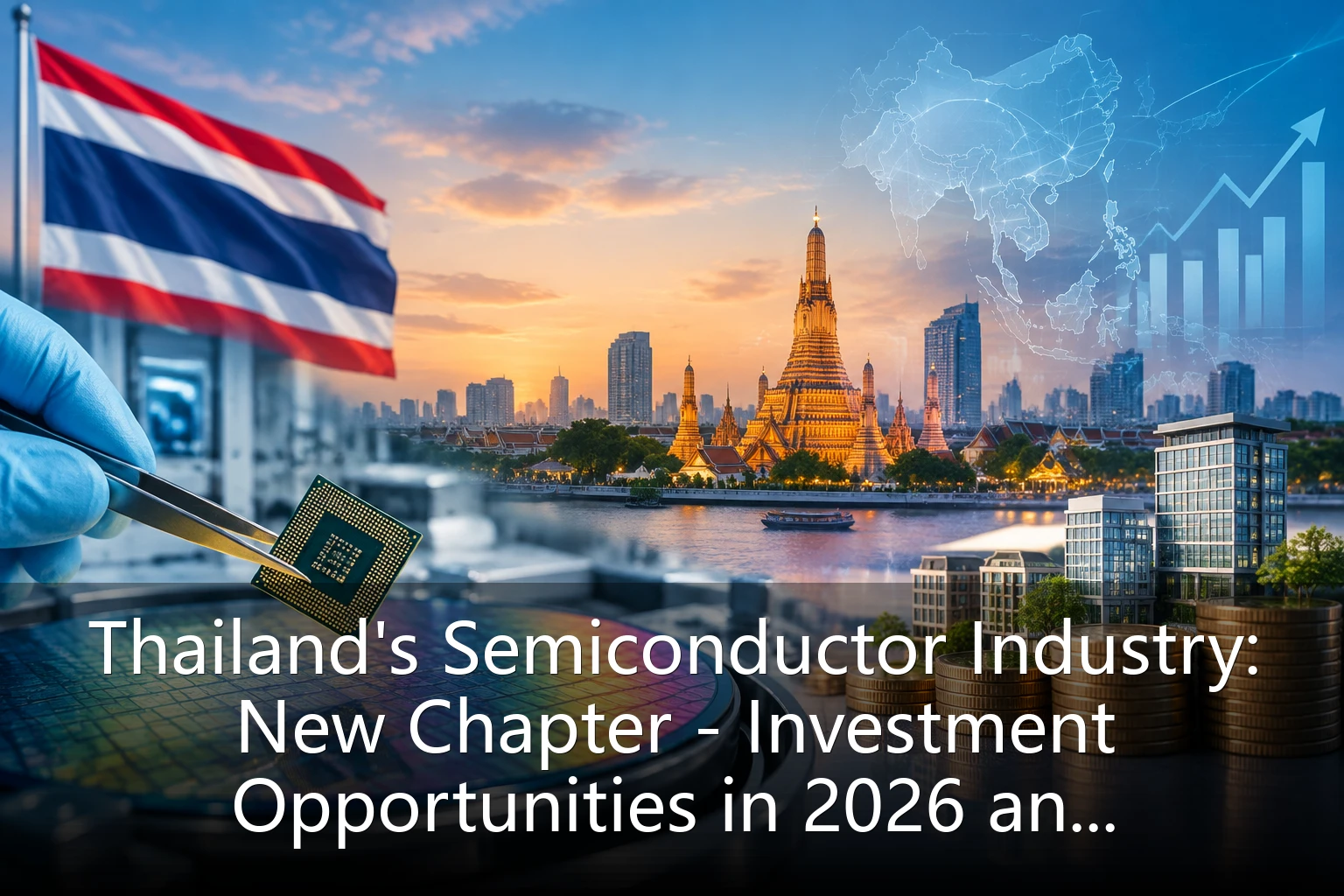
As the global semiconductor industry chain continues to restructure, Southeast Asia, particularly Thailand, is rapidly emerging as a new hub for the global chip industry. In the first three quarters of 2026, Thailand's semiconductor industry attracted record investments, not only driving local economic development but also reshaping the investment landscape of the Asia-Pacific real estate investment trust (REITs) market. This article will conduct an in-depth analysis of the latest development dynamics, investment opportunities, and impact on the regional real estate market of Thailand's semiconductor industry.
Thailand's Semiconductor Industry Enters a Golden Development Period
Since 2026, Thailand's semiconductor industry has shown unprecedented momentum. According to the latest data from the Thailand Board of Investment (BOI), as of September 2026, Thailand's semiconductor sector has accumulated investment applications exceeding $26.8 billion, an increase of nearly 45% compared to the same period in 2025. This figure not only sets a historical high but also makes Thailand one of the fastest-growing countries for semiconductor investment in Southeast Asia.
The rise of Thailand's semiconductor industry is not accidental but the result of multiple factors working together. First, the Thai government has continuously introduced preferential policies in recent years, providing support measures such as tax incentives and land use facilitation for the semiconductor industry. Second, Thailand's relatively stable political environment, complete infrastructure, and abundant human resources provide a solid foundation for semiconductor industry development. Additionally, the trend of global semiconductor industry chain shifting to Southeast Asia, combined with Thailand's strategic position as a regional supply chain node, has jointly driven the vigorous development of this industry in Thailand.
Major Investment Trends and Project Layout
Among numerous investment projects, the expansion of several international semiconductor giants in Thailand is particularly noteworthy. A leading South Korean memory chip manufacturer announced the construction of its first 12-inch wafer fab in Southeast Asia near Bangkok, with a total investment of $8.5 billion, expected to be operational by the end of 2027. This project will become an important milestone for Thailand's semiconductor industry, significantly enhancing Thailand's position in the regional semiconductor industry chain.
Meanwhile, multiple American and European semiconductor equipment manufacturers have also accelerated their layout in Thailand. A major Dutch semiconductor equipment manufacturer announced the establishment of a regional headquarters in Thailand's Eastern Economic Corridor (EEC), and plans to invest $1.2 billion to build an advanced packaging and testing center. This move will further strengthen Thailand's position as a semiconductor manufacturing and testing base.
Thai domestic enterprises are also不甘示弱 (not to be outdone), with several domestic semiconductor design companies receiving international investment to accelerate technology upgrades and capacity expansion. The rise of these domestic enterprises is gradually building a complete semiconductor industry chain in Thailand from design to manufacturing and testing.
Impact of Semiconductor Industry on Thailand's Real Estate Market
The vigorous development of the semiconductor industry has had a profound impact on Thailand's real estate market, especially in the industrial and commercial real estate sectors. With the expansion of semiconductor manufacturing and R&D facilities, demand for industrial real estate in related areas has surged, significantly increasing rental levels and investment values.
Surge in Industrial Real Estate Demand
In semiconductor industry clusters such as Bangkok's periphery, Chonburi Province, and Nonthaburi Province, the industrial real estate market shows a supply-demand imbalance. Data shows that in the first three quarters of 2026, the vacancy rate in Thailand's major industrial zones has fallen to a historic low of only 2.3%, while industrial real estate rents have increased by 18.5% year-on-year.
Particularly noteworthy is the growing demand from semiconductor enterprises for high-standard industrial facilities, including clean rooms, stable power supply, temperature and humidity control, and other special requirements. The limited supply of such high-quality industrial facilities has further increased property values in related areas.
Boom in Commercial Real Estate and Supporting Services
The agglomeration effect of the semiconductor industry has also driven the development of surrounding commercial real estate. With the increase in semiconductor enterprise employees, demand for office space, retail facilities, and food services has simultaneously risen. Around industrial parks, various commercial complexes have emerged like mushrooms after rain, forming a complete industrial ecosystem.
In addition, to meet the needs of high-skilled talent in semiconductor enterprises, the high-end residential market has also shown active momentum. Many semiconductor companies provide housing subsidies for employees, driving demand growth in the surrounding mid-to-high-end residential market.
New Opportunities in Asia-Pacific REITs Market
The rise of Thailand's semiconductor industry has brought new investment opportunities to the Asia-Pacific real estate investment trust (REITs) market. The special nature and high return characteristics of semiconductor-related real estate have made it an emerging asset category attracting REITs investors.
Rise of Semiconductor-themed REITs
Since 2026, multiple REITs management institutions in the Asia-Pacific region have begun to invest in semiconductor-related real estate. A large Singaporean REITs manager announced the establishment of a specialized fund focused on semiconductor industry real estate, planning to invest in semiconductor parks and related facilities in Thailand, Malaysia, and other Southeast Asian countries.
Thailand's domestic REITs market has also responded positively to this trend, with multiple industrial real estate REITs increasing their allocation of semiconductor-related assets. These REITs typically provide relatively stable cash flow and higher returns, attracting institutional investors seeking stable returns.
Adjustment of REITs Investment Strategies
As the value of semiconductor industry real estate increases, REITs management institutions are adjusting their investment strategies to increase allocation to semiconductor industry chain-related real estate. Compared with traditional industrial real estate, semiconductor industry real estate has higher technical thresholds and more stable long-term leases, providing REITs with more stable income sources.
At the same time, REITs are also paying attention to the cyclical characteristics of the semiconductor industry, reducing risks from single-industry fluctuations through diversified investment portfolios. For example, some REITs simultaneously invest in real estate for different segments of the semiconductor industry chain, such as manufacturing, R&D, and testing, to balance the risk-return characteristics of each segment.
Investment Challenges and Risk Analysis
Despite the strong development momentum of Thailand's semiconductor industry, investors still need to pay attention to risk factors and make rational investment decisions.
Industry Cyclical Risk
The semiconductor industry has obvious cyclical characteristics with large price fluctuations. As the global semiconductor market enters an adjustment period, related investment growth may slow down, which will affect the demand and value of semiconductor industry real estate. Investors need to closely monitor cyclical changes in the global semiconductor market and reasonably evaluate investment timing.
Policy Dependency Risk
The rapid development of Thailand's semiconductor industry depends to some extent on government preferential policy support. Future policy changes may affect the pace and direction of industrial development, thereby affecting the investment value of related real estate. Investors need to pay attention to the direction of Thailand's semiconductor industry policies and evaluate their stability and sustainability.
Technology Iteration Risk
The semiconductor industry has fast technology updates and new manufacturing processes and equipment constantly emerging. If Thailand cannot keep up with technology upgrades in time, it may lose competitiveness in the global semiconductor industry chain, affecting the long-term value of related real estate. Investors need to pay attention to Thailand's semiconductor industry technology upgrade capabilities and evaluate its long-term competitiveness.
Future Outlook and Investment Recommendations
Looking ahead, Thailand's semiconductor industry is expected to maintain strong growth momentum, providing more investment opportunities for the Asia-Pacific REITs market. Based on current development trends, we propose the following investment recommendations:
Long-term Allocation to Semiconductor Industry Real Estate REITs
For investors seeking long-term stable returns, consider allocating to REITs products focused on semiconductor industry real estate. These REITs typically have stable cash flow and higher returns, providing investors with long-term stable returns.
Pay Attention to Industry Chain Diversification Opportunities
The semiconductor industry chain covers multiple segments such as design, manufacturing, packaging, and testing, each with different real estate demand and characteristics. Investors can pay attention to REITs products that cover multiple segments of the industry chain, reducing risks of a single segment through diversified allocation.
Seize Regional Synergy Development Opportunities
With the coordinated development of the semiconductor industry in Southeast Asia, countries in the region form complementary advantages. Investors can pay attention to regional REITs products covering multiple Southeast Asian countries, seizing the dividends of regional coordinated development.
Pay Attention to New Opportunities Brought by Technological Innovation
Technological innovation in the semiconductor industry will continue to drive industrial upgrading, creating new real estate demand. Investors can pay attention to real estate investment opportunities related to emerging technologies such as third-generation semiconductors and AI chips, seizing the dividends brought by technological innovation.
Conclusion
The rise of Thailand's semiconductor industry has brought new development opportunities to the real estate market in Asia-Pacific, especially Thailand. The high return characteristics and stable demand of semiconductor industry real estate have made it an emerging asset category attracting REITs investors. However, investors also need to pay attention to the cyclical risks, policy dependency risks, and technology iteration risks of the semiconductor industry, making rational investment decisions.
With the continuous restructuring of the global semiconductor industry chain and the vigorous development of the semiconductor industry in Southeast Asia, Thailand's semiconductor industry real estate is expected to become an important investment target in the Asia-Pacific REITs market. For investors seeking long-term stable returns, paying attention to and appropriately allocating to semiconductor industry real estate REITs products may be an effective way to seize this round of industry opportunities.