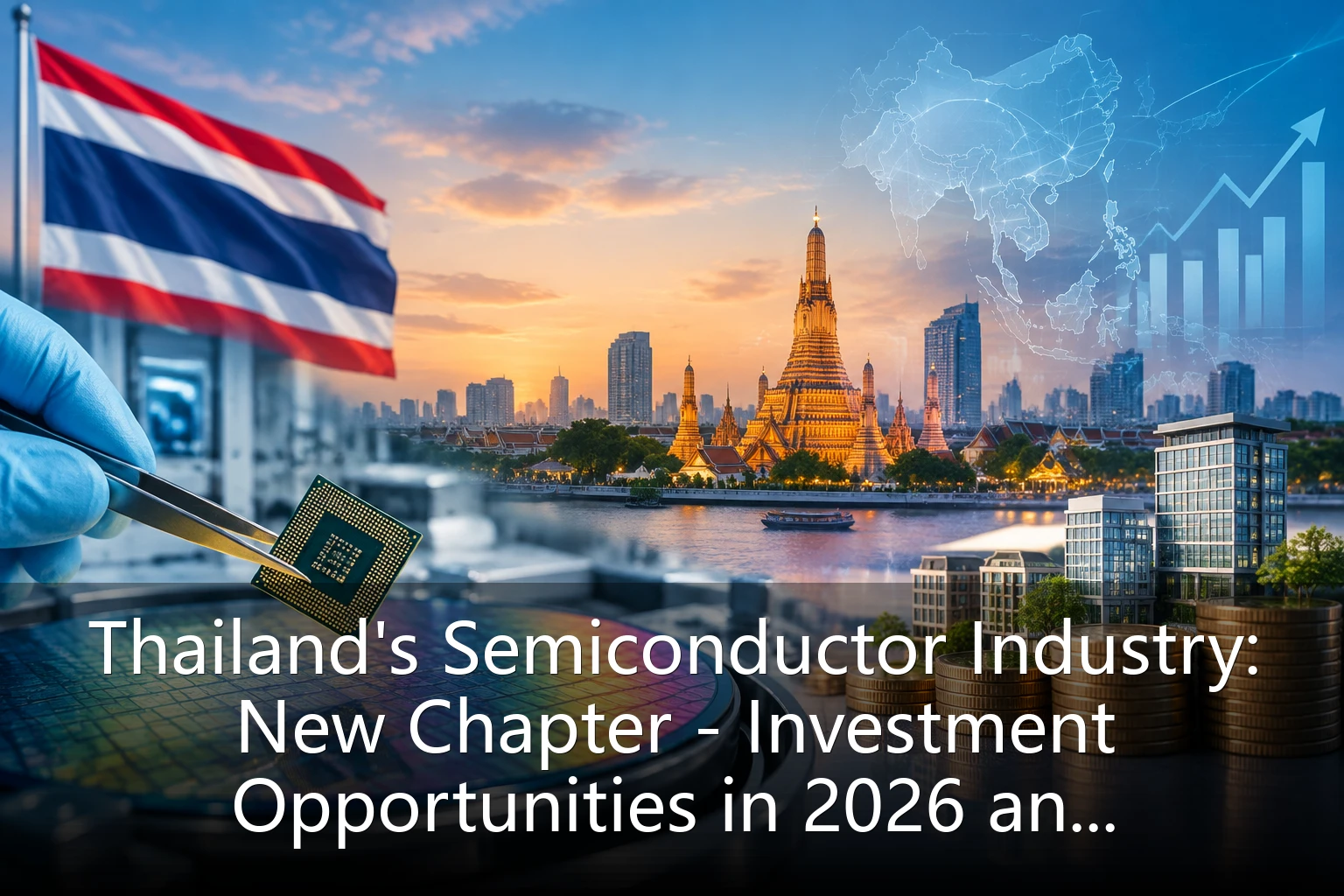
In recent years, Thailand's semiconductor industry has rapidly emerged as a crucial part of the global semiconductor supply chain. With the adjustment of the global semiconductor industry landscape and the rapid economic development of the Southeast Asian region, Thailand is becoming a hotbed for global semiconductor industry investment thanks to its unique geographical location, policy support, and industrial foundation. This article will provide an in-depth analysis of the current status and future trends of Thailand's semiconductor industry and its impact on the Asia-Pacific REITs market, offering comprehensive industry insights for investors.
Historical Development and Current Status of Thailand's Semiconductor Industry
Thailand's semiconductor industry began in the 1990s, initially focusing mainly on electronic assembly and testing. After entering the 21st century, with the rise of the global semiconductor industry transfer wave, Thailand began to attract more high-value-added semiconductor manufacturing processes. Especially after 2010, the Thai government listed the semiconductor industry as a national key development industry and introduced a series of preferential policies, attracting major international semiconductor giants including Intel, Toshiba, and ASE to establish production bases in Thailand.
According to data from the Thailand Board of Investment (BOI), by 2026, Thailand's semiconductor industry has formed a complete industrial chain, covering all aspects from chip design, manufacturing, to packaging and testing. Currently, Thailand has become the world's third-largest semiconductor packaging and testing base, second only to mainland China and Taiwan. Especially in the fields of automotive chips and industrial control chips, Thailand has established a clear competitive advantage.
Policy Support and Industrial Layout
The Thai government's support for the semiconductor industry continues to increase. In 2026, the Thai government launched an upgraded version of the "Thailand 4.0" strategy, listing the semiconductor industry as one of the ten key national development industries. The government plans to invest more than 100 billion Thai baht (approximately 3 billion US dollars) in the next five years for infrastructure construction, talent development, and technology research and development in the semiconductor industry.
In terms of industrial layout, Thailand has formed an industrial cluster centered on Bangkok with the Eastern Economic Corridor (EEC) as the focus. As a special economic zone that Thailand prioritizes for development, the Eastern Economic Corridor has attracted significant semiconductor investment. According to statistics, by 2026, the Eastern Economic Corridor has attracted more than 200 semiconductor-related enterprises to settle in, with a total investment exceeding 500 billion Thai baht.
Competitive Advantage Analysis of Thailand's Semiconductor Industry
Geographical Location and Regional Synergy Advantages
Thailand is located in the center of Southeast Asia, serving as an important hub connecting South Asia, Southeast Asia, and Oceania. This geographical position makes Thailand an ideal node for the regional semiconductor supply chain. Especially with the construction of the "ASEAN semiconductor industry chain," Thailand is playing an increasingly important role in regional synergy.
Thailand has formed good industrial complementary relationships with neighboring countries. Malaysia and Vietnam have advantages in chip design and manufacturing, while Thailand performs well in packaging, testing, and high-end application areas. This regional synergy effect makes Thailand's semiconductor industry more competitive.
Industrial Foundation and Talent Reserve
Thailand has a relatively complete electronic industry foundation and is an important global electronics production base. This foundation provides a broad application market and supporting services for the semiconductor industry. Especially in the fields of automotive electronics, industrial control, and consumer electronics, Thailand has established a strong industrial ecosystem.
In terms of talent reserves, the Thai government highly values talent cultivation in the semiconductor field. Currently, Thailand has cooperated with many internationally renowned universities to establish semiconductor-related majors and has set up multiple semiconductor technology training centers. According to statistics, Thailand trains more than 5,000 semiconductor professionals annually, basically meeting the needs of industrial development.
Policy Environment and Investment Attractiveness
To attract semiconductor investment, the Thai government has introduced a series of preferential policies, including an 8-year corporate income tax exemption, import duty exemption, and land lease benefits. Especially for high-value-added technology-intensive projects, the government provides more favorable policy support.
In addition, Thailand actively participates in regional economic integration and is an important member of the ASEAN Free Trade Area and RCEP. This facilitates the regional circulation of semiconductor products, reduces trade costs, and enhances the international competitiveness of Thailand's semiconductor industry.
Market Prospects and Trends of Thailand's Semiconductor Industry
Opportunities Brought by Changes in the Global Semiconductor Industry Landscape
Currently, the global semiconductor industry is in a period of deep adjustment. On one hand, Sino-US trade frictions and geopolitical factors have prompted countries to seek supply chain diversification and reduce dependence on a single country; on the other hand, the global digital transformation and the development of emerging application fields continue to drive semiconductor demand growth. These changes have brought unprecedented development opportunities for Thailand's semiconductor industry.
Especially with the intensification of the "de-globalization" trend, multinational semiconductor companies are actively seeking to establish diversified production bases in Southeast Asia to reduce geopolitical risks. With its stable political environment, complete infrastructure, and good industrial foundation, Thailand has become one of the preferred locations for these companies to deploy in Southeast Asia.
Promotion of Emerging Application Fields
The rapid development of emerging application fields such as artificial intelligence, Internet of Things, 5G communication, and autonomous driving has brought huge market space for the semiconductor industry. Thailand has begun to layout in these fields, especially in automotive chips and industrial control chips, where Thailand has established a clear competitive advantage.
Taking automotive chips as an example, Thailand is an important global automobile production base with an annual output of more than 2 million vehicles. With the acceleration of the electrification and intelligence trends in automobiles, the demand for automotive chips is showing explosive growth. Thailand's automotive chip industry has formed a complete industrial chain from design, manufacturing to packaging and testing, with strong market competitiveness.
Technological Innovation and Industrial Upgrading
Thailand's semiconductor industry is extending from traditional packaging and testing processes to high-value-added chip design and manufacturing. The government guides and supports through policies and funds to encourage enterprises to increase R&D investment and enhance technological innovation capabilities. Especially in the fields of third-generation semiconductors and advanced packaging technologies, Thailand has achieved certain breakthroughs.
In 2026, Thailand's semiconductor industry has made a series of important achievements in technological innovation. Many local enterprises have successfully developed chip products with independent intellectual property rights and achieved commercial application. These technological innovations have laid the foundation for Thailand's semiconductor industry to climb to the high end of the value chain.
Impact of Thailand's Semiconductor Industry on the Asia-Pacific REITs Market
Rise of Semiconductor Industrial Park REITs
With the rapid development of Thailand's semiconductor industry, semiconductor industrial park REITs have emerged. These REITs mainly invest in the infrastructure, factories, and supporting facilities of semiconductor industrial parks, providing one-stop services for semiconductor enterprises. By 2026, Thailand has established 5 semiconductor industrial park REITs with a total market value exceeding 200 billion Thai baht.
The emergence of semiconductor industrial park REITs provides investors with a new channel to participate in the development of the semiconductor industry. By investing in these REITs, investors can share the benefits of rental growth and asset appreciation from semiconductor industrial parks, while avoiding the high risks of direct investment in semiconductor companies.
Investment Opportunities in Related Industrial Chain REITs
In addition to semiconductor industrial park REITs, the development of Thailand's semiconductor industry has also driven the rise of related industrial chain REITs. Including logistics REITs, data center REITs, and industrial REITs, these REITs provide supporting services for the semiconductor industry and benefit from its rapid development.
Taking logistics REITs as an example, the semiconductor industry has extremely high requirements for logistics efficiency, requiring stable supply chains and efficient logistics support. With the development of Thailand's semiconductor industry, the occupancy rates and rental levels of related logistics REITs continue to increase, bringing stable returns for investors.
Risk Assessment and Investment Strategy
Although Thailand's semiconductor industry REITs have good investment prospects, investors still need to pay attention to related risks, including industrial policy change risks, technology iteration risks, and market competition risks. Investors should adopt a diversified investment strategy and focus on projects with core competitiveness and stable cash flow.
For long-term investors, Thailand's semiconductor industry REITs have good investment value. With the continuous development of Thailand's semiconductor industry and the enhancement of its regional position, the asset value and rental income of related REITs are expected to grow steadily, providing stable long-term returns for investors.
Conclusion and Investment Recommendations
Thailand's semiconductor industry is in a stage of rapid development, and its position in the global semiconductor supply chain is continuously improving. With the increase in policy support, the enhancement of regional synergy effects, and the promotion of emerging application fields, the future development prospects of Thailand's semiconductor industry are broad.
For the Asia-Pacific REITs market, the rise of Thailand's semiconductor industry has brought new investment opportunities. Semiconductor industrial park REITs and related industrial chain REITs provide investors with new channels to participate in the development of the semiconductor industry. Investors can focus on projects with core competitiveness and stable cash flow, adopt a diversified investment strategy, to obtain long-term stable investment returns.
Overall, the rise of Thailand's semiconductor industry is not only an important engine for Thailand's economic transformation and upgrading but also brings new growth points for the Asia-Pacific REITs market. Investors should pay close attention to the development dynamics of Thailand's semiconductor industry, grasp investment opportunities, and achieve asset preservation and appreciation.