Semiconductor Sector Surges: AI Computing Demand Cascades Through Entire Chain, Equipment and Chip ETFs Attract Capital
Introduction
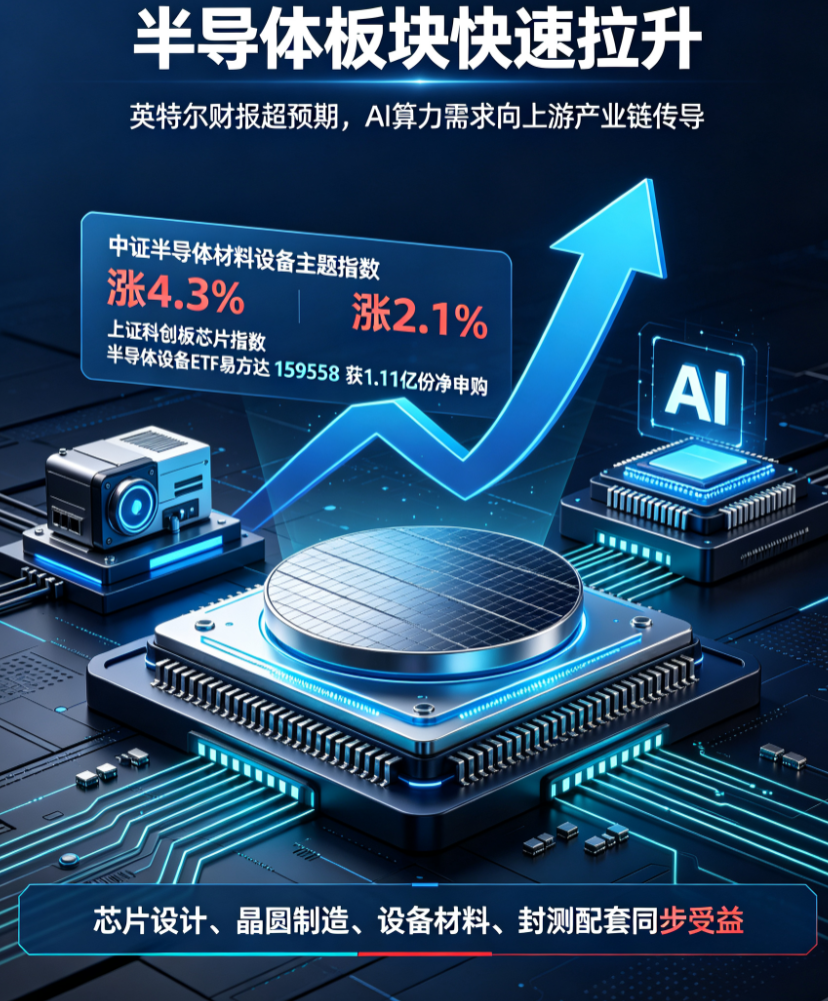
On July 24, 2026, the A-share semiconductor sector experienced a collective surge in the afternoon. As of 13:31, the CSI Semiconductor Materials & Equipment Theme Index rose 4.3%, and the SSE STAR Market Chip Index rose 2.1%, with significantly active market trading. Meanwhile, the Semiconductor Equipment ETF (159558) saw net subscriptions of 111 million shares during trading, with accelerating capital inflows reflecting investors' strong expectations for the future growth of the semiconductor industry chain. The direct catalyst for this round of market movement came from semiconductor giant Intel's better-than-expected quarterly earnings report, with the deeper logic being that AI computing demand is transmitting from cloud vendors' capital expenditure to chip design, wafer manufacturing, and upstream equipment across the entire chain, driving the entire semiconductor industry into a new upcycle.
1. Intel Earnings Beat: AI and Data Center Business Become Growth Engine
On July 23 local time, Intel released its Q2 2026 earnings report. Data showed the company's quarterly revenue reached $16.13 billion, up 25% year-over-year, not only marking the strongest quarterly growth in nearly fifteen years but also exceeding market expectations by nearly 12%. This result far surpassed analysts' previous estimates and signals that Intel, after years of strategic adjustment, is ushering in a performance inflection point.
Among specific business segments, the data center and AI business performed particularly strongly, with revenue up 59% year-over-year to $6.3 billion, becoming the biggest growth driver for the company. As global enterprises' demand for AI training and inference computing continues to rise, Intel's layout in data center CPUs, GPUs, and AI accelerators is beginning to yield results. Meanwhile, foundry business revenue grew 31% year-over-year, indicating that Intel's IDM 2.0 strategy is making substantial progress with steady growth in external customer orders.
More notably, Intel raised its 2026 capital expenditure forecast to over $20 billion and expects 2027 to be significantly higher than 2026. This signal is extremely important: massive capital expenditure means Intel is accelerating the construction of advanced process capacity to meet the explosion in demand for AI chips and high-performance computing. Analysts point out that sustained high capital expenditure helps boost sentiment in the upstream AI infrastructure market and enhances demand certainty for the chip, server, and data center support industry chain.
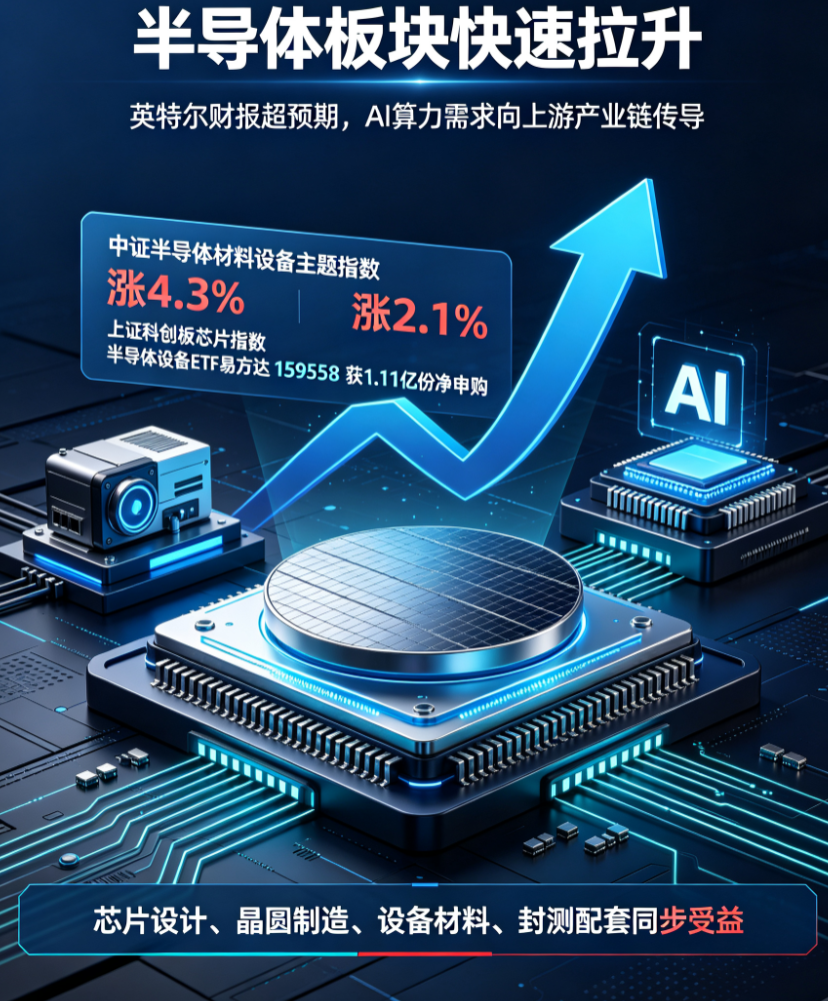
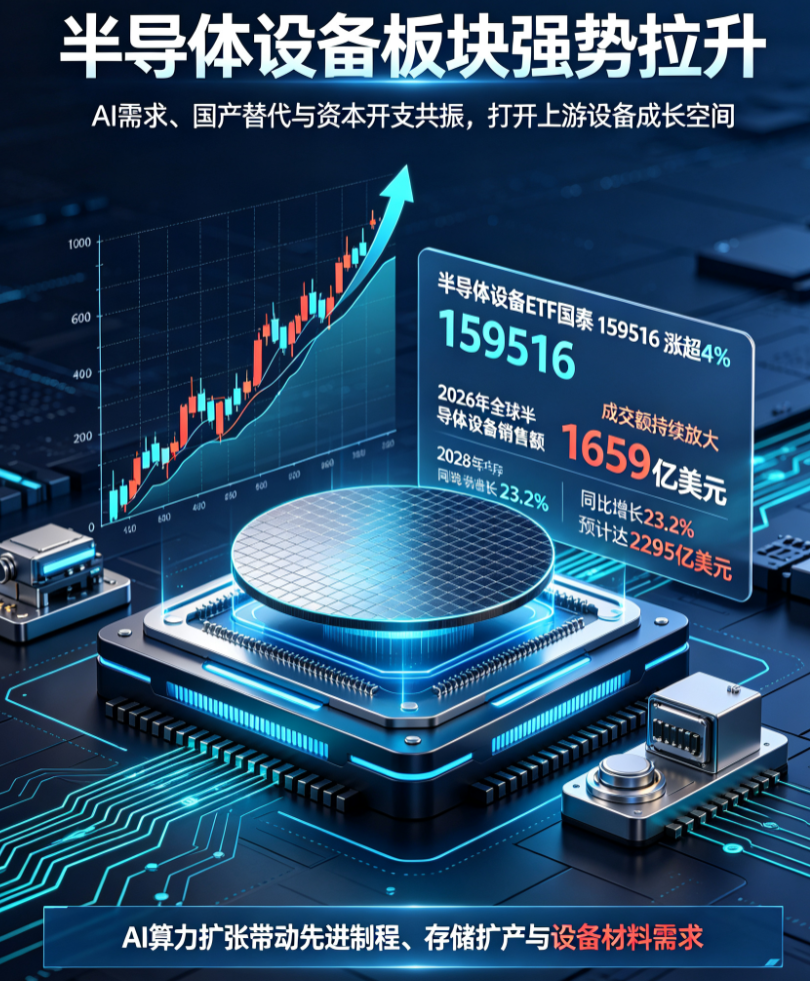
As shown in the chart above, the semiconductor sector experienced a rapid surge this afternoon, with the CSI Semiconductor Materials & Equipment Theme Index and the SSE STAR Market Chip Index rising simultaneously, and capital sentiment clearly heating up.
2. AI Computing Demand Transmits Across the Entire Chain: Certain Benefits from Cloud Vendors to Equipment Makers
Intel's earnings report is not an isolated case. Over the past few quarters, global cloud service giants represented by Microsoft, Amazon, and Google have successively raised their AI-related capital expenditure plans, and this trend is transmitting to upstream and downstream links. Traditionally, the market has often focused more on the prosperity of the chip design segment, but the particularity of this round of AI computing demand lies in that it not only drives the iteration of advanced logic chips but also pulls the expansion of the entire semiconductor manufacturing ecosystem.
Specifically, AI training and inference require a large number of high-performance GPUs, ASICs, and HBM memory chips, which generally adopt the most advanced process technologies (e.g., 5nm, 3nm, or even 2nm) and demand far greater wafer foundry capacity than traditional chips. Chip design companies represented by NVIDIA, AMD, etc., are continuously placing huge orders with foundries like TSMC and Samsung, thereby driving foundries to increase capital expenditure and expand advanced process production lines. The expansion of foundries directly stimulates demand for upstream semiconductor equipment and materials—orders for lithography machines, etching equipment, thin-film deposition equipment, inspection equipment, and various high-purity chemicals surge accordingly.
From the perspective of A-share listed companies, domestic semiconductor equipment and materials companies are at key nodes of this transmission chain. Leading etching and thin-film deposition equipment makers like AMEC and NAURA, as well as materials companies like NSIG and Tongcheng New Materials, have performance growth highly correlated with the pace of global wafer fab expansion. Additionally, STAR Market chip design companies such as Hygon Information and Loongson Technology are accelerating product iteration in areas like AI inference and edge computing.
Market analysis points out that AI computing demand is transmitting from cloud vendors' capital expenditure to chip design, wafer manufacturing, and upstream equipment across the entire chain, and all segments of the semiconductor industry chain are expected to benefit. This judgment is being continuously verified: Intel's upward revision of capital expenditure will further strengthen this logic and drive up profit expectations for the entire chain.
3. Seizing Structural Opportunities: Investment Tools for Equipment and Chip Sides
For ordinary investors, how to precisely seize the growth opportunities in this round of semiconductor industry chain? Index investing provides an efficient and convenient path. Currently, two ETF products highly related to the semiconductor industry are worth attention.
Semiconductor Equipment ETF (159558, Feeder Fund A/C: 021893/021894) tracks the CSI Semiconductor Materials & Equipment Theme Index, focusing on the most defensible equipment and materials segments in the upstream semiconductor industry chain. The index's constituent stocks mainly include leaders in etching equipment, thin-film deposition equipment, lithography equipment, inspection equipment, as well as wafers, photoresist, electronic specialty gases, and other materials. Against the backdrop of continuous expansion of domestic wafer fabs and accelerated import substitution, the equipment and materials segment is one of the sub-sectors with the highest growth certainty in the semiconductor industry. Today's net subscriptions of 111 million shares in this ETF are a positive market recognition of this logic.
STAR Chip ETF (589130, Feeder Fund A/C: 020670/020671) tracks the SSE STAR Market Chip Index, gathering STAR Market leaders covering the full chain of chip design, manufacturing, packaging, and testing. The STAR Market chip companies are often at the technological frontier, with strong competitiveness in AI chips, analog chips, memory chips, etc., and benefit from dual support of domestic policies and markets. The index covers the complete chain from upstream design to downstream packaging and testing, reflecting the growth trend of the domestic chip industry comprehensively.
The two ETFs respectively target the equipment side and the chip side, allowing investors to allocate according to their own risk preferences and investment goals. For those wishing to profit from the full-chain transmission of AI computing demand, they can pay attention to both directions to achieve a "full-dimensional" layout from equipment to chips. It is worth noting that ETFs are flexible and low-cost, especially suitable for phased position building during market fluctuations.
Conclusion
Intel's earnings beat and significant capital expenditure upward revision further confirm the upcycle of the semiconductor industry driven by AI computing demand. From cloud vendors to chip design, from wafer foundry to equipment and materials, the prosperity of the entire chain is rising simultaneously. Today's rapid surge in the A-share semiconductor sector and concentrated subscriptions in semiconductor equipment ETFs are the market's positive response to this trend.
Looking ahead, with the continuous advancement of global AI infrastructure construction and the deepening of domestic semiconductor independent controllability strategies, the semiconductor industry chain is expected to see dual improvements in performance and valuation. For investors, rationally using tool-type products such as the Semiconductor Equipment ETF and the STAR Chip ETF can reduce the risk of individual stock selection while sharing the long-term dividends of semiconductor industry growth. Of course, short-term market fluctuations are inevitable, and investors should still make rational decisions and long-term allocations based on their own risk tolerance.