The Rise of Thailand's Semiconductor Industry: How Bootcamps Cultivate the Next Generation of Chip Talent
\n\nIn 2026, Thailand's semiconductor industry is experiencing a historic development opportunity. As the global semiconductor supply chain accelerates its restructuring, Thailand has become a hotbed for semiconductor investment, leveraging its unique geographical location, policy advantages, and stable investment environment. However, as the industry grows rapidly, the shortage of professional talent has become increasingly prominent, emerging as a key bottleneck constraining the upgrading of Thailand's semiconductor industry. Against this backdrop, semiconductor bootcamps have emerged, providing urgently needed professional talent for Thailand's semiconductor industry through systematic and specialized training systems.
\n\nThe Golden Development Period of Thailand's Semiconductor Industry
\n\nIn recent years, Thailand's semiconductor industry has shown unprecedented growth momentum. According to the latest data from the Thailand Board of Investment (BOI), between 2023 and 2026, Thailand's semiconductor sector has attracted cumulative investments exceeding $30 billion, with 27 new projects including wafer fabs, packaging and testing plants, and R&D centers. This figure not only sets a new high in Thailand's semiconductor industry history but also makes Thailand the fastest-growing country in Southeast Asia for semiconductor investment.
\n\nThe Eastern Economic Corridor (EEC), as a special economic zone prioritized by the national government, has become a core gathering place for the semiconductor industry. Currently, the EEC has attracted numerous enterprises including international semiconductor giants such as TSMC, Infineon, and Micron, forming a complete industrial chain from wafer manufacturing, packaging and testing to R&D and design. Particularly in the first half of 2026, Thailand's government announced the "200 billion baht chip incentive plan," which has further attracted leading global semiconductor companies to increase their investment in Thailand.
\n\nThe rise of Thailand's semiconductor industry is no accident. On one hand, the trend of global semiconductor supply chain restructuring is evident, with countries seeking diversified layouts. Thailand has become the preferred destination for multinational companies to diversify risks, thanks to its political stability, superior geographical location, relatively low labor costs, and good relations with semiconductor powerhouses like the United States and Japan. On the other hand, the Thai government actively promotes the "Thailand 4.0" strategy, listing the semiconductor industry as a key development area and accelerating industrial clustering through policy support in tax incentives, land supply, talent training, and other aspects.
\n\nTalent Gap: The Biggest Challenge for Thailand's Semiconductor Industry Development
\n\nDespite the continued investment boom in Thailand's semiconductor industry, the talent shortage problem has become increasingly prominent. The "2026 Semiconductor Talent Supply and Demand Report" released by the Thailand Engineering Institute (ETI) shows that Thailand's semiconductor industry faces a talent gap of up to 32,000 people, with particularly severe shortages in core areas such as chip design, manufacturing processes, and packaging and testing. It is estimated that by 2030, this gap will expand to more than 50,000 people.
\n\nThere are three main reasons for the talent shortage: First, Thailand's domestic higher education system for semiconductors is relatively weak, with traditional university curricula disconnected from actual industry needs. Second, semiconductor technology updates and iterations are rapid, making it difficult for existing employees' knowledge structures to keep up with technological development. Third, R&D centers established by international semiconductor giants in Thailand require a large number of high-end talents with international perspectives, which are extremely scarce in the Thai market.
\n\nThe talent shortage has become a key factor constraining the high-quality development of Thailand's semiconductor industry. Many companies face the dilemma of "having equipment but no talent" when expanding production capacity, and some newly built advanced production lines cannot reach full capacity due to lack of skilled operators. At the same time, talent shortages have also led to vicious competition among enterprises, driving up labor costs and weakening the overall competitiveness of Thailand's semiconductor industry.
\n\nSemiconductor Bootcamps: A Key Measure to Solve the Talent Crisis
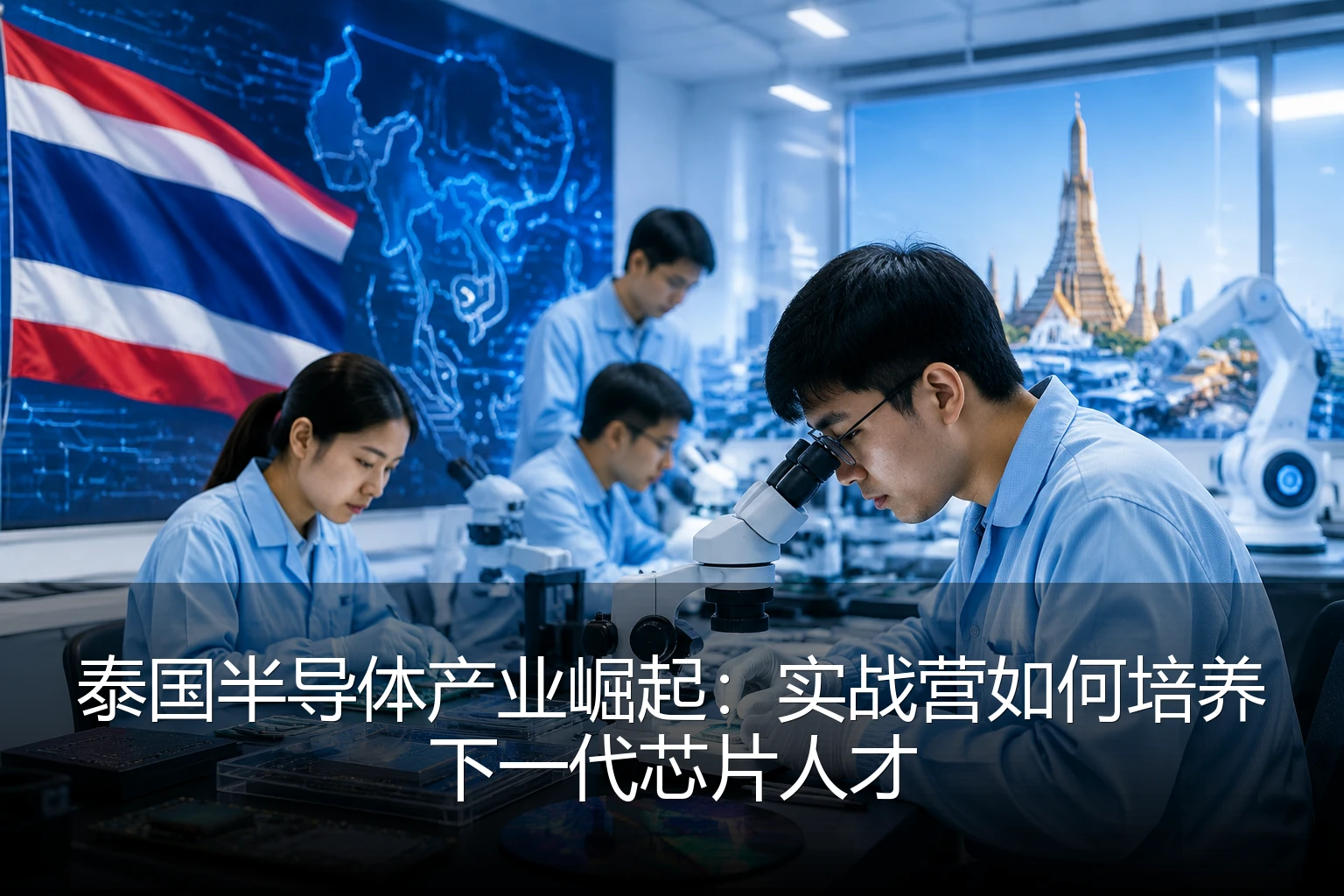
\n\nFacing severe talent challenges, Thailand's government, industry associations, and enterprises have taken action, with semiconductor bootcamps emerging as an innovative model for cultivating practical talents. Different from traditional higher education, semiconductor bootcamps adopt a "industry-education integration, practice-oriented" training model, where industry-leading enterprises and professional training institutions cooperate to design courses based on actual industry needs and cultivate students' practical skills through project-based practice.
\n\nCurrently, Thailand mainly has three types of semiconductor bootcamps: First, government-led national bootcamps, such as the "Thailand Semiconductor Talent Incubation Program" jointly established by Thailand's Ministry of Science and Technology and BOI. Second, bootcamps organized by industry alliances, such as the "Semiconductor Elite Training Program" jointly carried out by the Thailand Semiconductor Industry Association (TSIA) and multiple enterprises. Third, corporate internal bootcamps, such as the "Wafer Manufacturing Technology Training Center" established by TSMC Thailand.
\n\nThese bootcamps closely integrate industry needs in their curriculum design, covering the entire process from chip design, manufacturing processes, packaging and testing to quality control. The training content not only includes theoretical knowledge but emphasizes the cultivation of practical operational skills. By participating in real projects, students complete the entire process from design to manufacturing under the guidance of senior engineers, quickly mastering the core skills required by the industry.
\n\nInnovative Training Models of Bootcamps
\n\nThe key to the success of semiconductor bootcamps lies in their innovative training models. Compared with traditional education, bootcamps have the following distinctive features:
\n\n- \n
- Deep Industry-Education Cooperation: Bootcamps are directly involved in curriculum design and teaching implementation by industry-leading enterprises, ensuring seamless alignment between training content and industry needs. Corporate mentors regularly teach, sharing the latest technical dynamics and industry experiences, enabling students to stay updated on industry frontiers. \n
- Project-Driven Learning: Bootcamps adopt the "learning by doing" teaching philosophy, where students master knowledge and skills by participating in actual projects and solving problems. Each project simulates real work scenarios, cultivating students' engineering thinking and teamwork abilities. \n
- Dual-Track Training: Bootcamps adopt a dual-track training model of "theory + practice." Students need to master basic theoretical knowledge such as semiconductor physics and materials science, as well as skillfully operate advanced equipment to complete actual production tasks. \n
- International Perspective: In response to the international characteristics of Thailand's semiconductor industry, bootcamps particularly focus on cultivating students' cross-cultural communication skills and international standard awareness, enabling them to adapt to the work environment of multinational enterprises. \n
Taking the "Chip Manufacturing Technology Bootcamp" in the Thailand EEC semiconductor cluster as an example, this bootcamp cooperates with enterprises such as TSMC and Infineon to establish a simulated wafer production line, where students can participate in the complete process from wafer cleaning, lithography, etching to packaging and testing. The bootcamp also introduces advanced Semiconductor Manufacturing Execution Systems (MES), allowing students to familiarize themselves with the operation and management of modern semiconductor factories.
\n\nSignificant Achievements of Bootcamps
\n\nSince 2023, Thailand's semiconductor bootcamps have trained more than 5,000 professional talents, effectively alleviating the industry's talent shortage. According to Thailand's BOI statistics, the employment rate of bootcamp graduates is as high as 95%, with 80% of graduates entering the semiconductor industry, and their average starting salary is 30% higher than that of ordinary university graduates.
\n\nSemiconductor bootcamps have not only delivered a large number of practical talents to enterprises but also promoted deep integration of industry, academia, and research. Many bootcamp students have participated in actual enterprise projects during their training, contributing to technological innovation and process improvements. Some outstanding students have even obtained formal positions in enterprise R&D departments, becoming the backbone of technological innovation.
\n\nThe success of bootcamps has also driven the overall improvement of Thailand's semiconductor industry. As more professionally trained talents enter the industry, the production efficiency and quality control levels of Thai semiconductor enterprises have significantly improved, with product yield increasing by an average of 5-8 percentage points, enhancing the market competitiveness of Thailand's semiconductor products.
\n\nFuture Outlook and Development Recommendations
\n\nLooking ahead, as the global semiconductor industry continues to shift to Southeast Asia, Thailand's semiconductor industry will embrace broader development space. As an important carrier of talent cultivation, semiconductor bootcamps also need to continuously innovate and improve to adapt to new industry development needs.
\n\nFirst, bootcamps need to further deepen industry-education integration, strengthen cooperation with enterprises, and establish closer industry-academia-research collaboration mechanisms. Enterprises should more deeply participate in the teaching process of bootcamps, provide more real projects and cases, and make training content closer to actual industry needs.
\n\nSecond, bootcamps need to strengthen international cooperation and introduce advanced international training resources and standards. Establish cooperative relationships with world-leading semiconductor enterprises and educational institutions to jointly develop training courses and enhance the international level of bootcamps.
\n\nThird, bootcamps need to pay attention to the development trends of emerging technologies and adjust training content in a timely manner. With the rise of new technologies such as third-generation semiconductors and AI chips, bootcamps need to proactively layout related training areas to reserve talents for future industry development.
\n\nFinally, the government should increase support for semiconductor bootcamps, provide more policy incentives and financial support, encourage more enterprises to participate in bootcamp construction, and form a diversified talent cultivation system guided by the government, led by enterprises, and participated by society.
\n\nThe emergence of semiconductor bootcamps marks an important step for Thailand in cultivating semiconductor professionals. Through this innovative talent cultivation model, Thailand is gradually solving the talent bottleneck in semiconductor industry development, laying a solid foundation for building a new global center for semiconductor manufacturing. With the expansion and quality improvement of bootcamps, Thailand is expected to become an important global talent cultivation base for semiconductors in the next 5-10 years, contributing more "Made in Thailand" professional talents to the global semiconductor industry.
\n\nIn the context of increasingly fierce competition in the global semiconductor industry, talent has become a key factor determining industrial competitiveness. The successful experience of Thailand's semiconductor bootcamps not only provides strong support for the sustainable development of Thailand's semiconductor industry but also offers useful references for other developing countries to develop their semiconductor industries and solve talent shortage problems. In the future, with the continuous improvement and innovation of the bootcamp model, Thailand's semiconductor industry will surely embrace a more brilliant development prospect.