
Frontiers of Chip Technology: How Semiconductor Bootcamps Lead the Next Generation of Engineers to Master Future Technologies
\n\nThe global semiconductor industry is at a critical period of technological transformation. With the rapid development of emerging applications such as artificial intelligence, 5G communication, and the Internet of Things, chip technology is iterating at an unprecedented pace. Against this backdrop, semiconductor bootcamps, as an important bridge connecting industry and education, are playing an increasingly vital role. This article will delve into the latest developments in chip technology frontiers, analyze how semiconductor bootcamps respond to industry changes, cultivate engineers with advanced technical skills, and look forward to the future development path of the semiconductor industry in Southeast Asia, particularly Thailand.
\n\nLatest Breakthroughs in Chip Technology Frontiers
\n\nCurrently, chip technology frontiers are mainly concentrated in several key areas: advanced process technologies, new packaging technologies, third-generation semiconductor materials, and AI-specific chip design. Leading manufacturers like TSMC and Samsung have started mass-producing 3-nanometer chips and are actively developing 2-nanometer and below processes. Meanwhile, Chiplet technology and advanced packaging technologies such as CoWoS (Chip-on-Wafer-on-Substrate) and 2.5D/3D packaging are becoming important ways to enhance chip performance.
\n\nIn terms of materials, third-generation semiconductor materials represented by silicon carbide (SiC) and gallium nitride (GaN) show great potential in high-power, high-frequency applications. These materials can withstand higher operating temperatures and voltages, making them suitable for high-growth application scenarios such as electric vehicles, 5G base stations, and photovoltaic inverters. According to industry data, the global third-generation semiconductor market is expected to reach $30 billion by 2026, with a compound annual growth rate exceeding 25%.
\n\nThe AI chip sector has also achieved significant breakthroughs. Major companies like NVIDIA, AMD, and Intel have successively launched dedicated AI processors that use architectural innovations and specialized designs to greatly improve AI computing efficiency. Chips specifically for large language model training and inference have become the focus of competition among major manufacturers.
\n\nInnovative Training Models of Semiconductor Bootcamps
\n\nFacing the rapid iteration of chip technology, traditional semiconductor education models can no longer meet industry needs. Semiconductor bootcamps help students quickly master cutting-edge technologies through an innovative "theory + practice" training model. These bootcamps are typically jointly established by leading industry enterprises, universities, and research institutions, with course content closely integrated with the latest industry developments.
\n\nIn terms of curriculum, semiconductor bootcamps have expanded from traditional process technologies to multiple frontier areas:
\n\n- \n
- Advanced Process Technology Training: Including key process nodes for 3nm/2nm processes, EUV lithography technology, advanced etching and deposition processes, etc. \n
- Chiplet Design and Integration: Teaching cutting-edge knowledge such as small chip architecture design, interconnection technology, and 3D-IC design methodologies. \n
- Advanced Packaging Technologies: Covering the latest packaging processes such as 2.5D/3D packaging, fan-out packaging, and through-silicon via (TSV) technology. \n
- Third-Generation Semiconductor Processes: Providing complete training from wafer growth to device manufacturing for the special process requirements of SiC and GaN materials. \n
- AI Chip Design: Including neural network processor architecture, dedicated accelerator design, and hardware-software co-optimization. \n
The Rise of Thailand's Semiconductor Industry and Talent Development
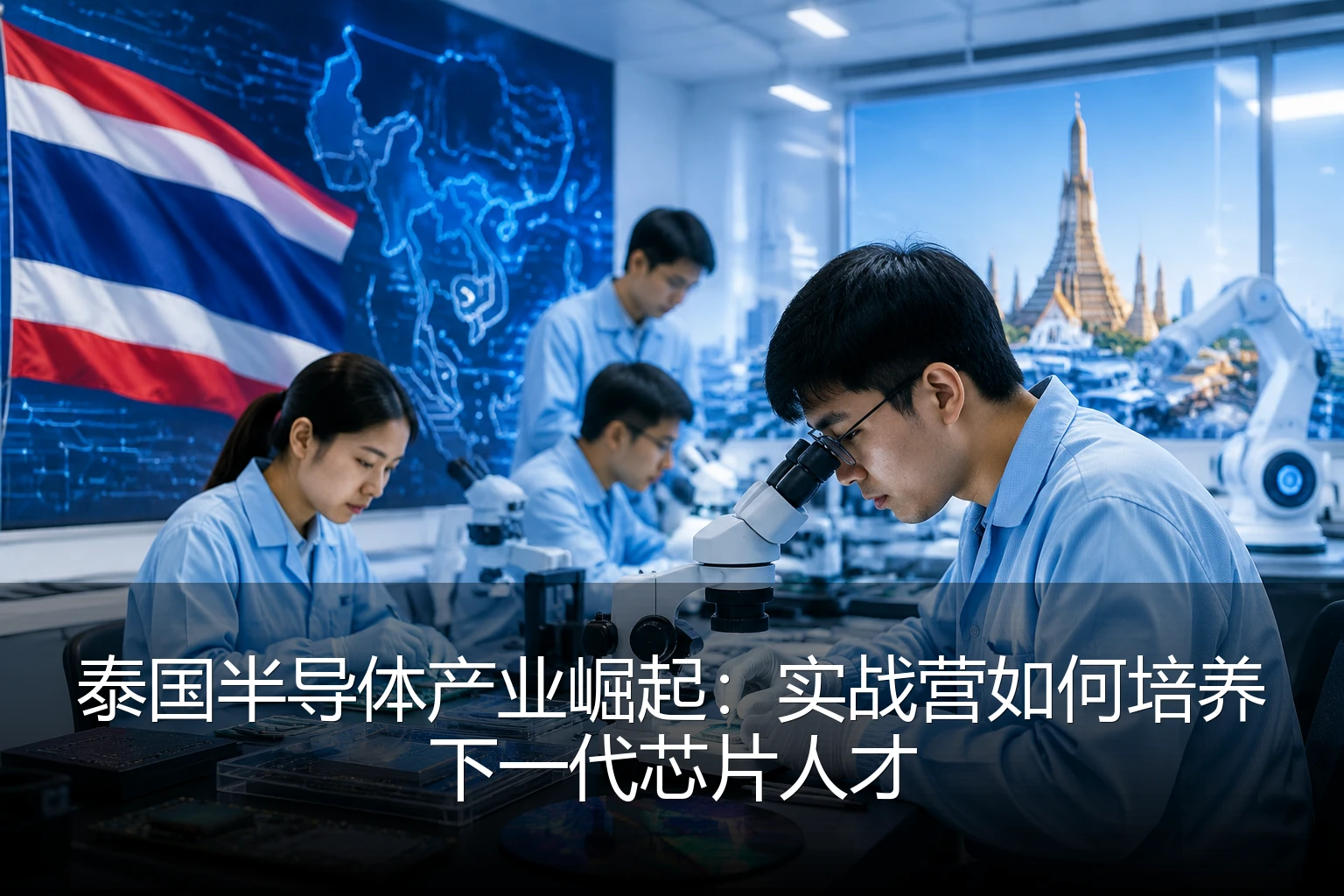
\n\nThailand is rapidly becoming an important hub for the semiconductor industry in Southeast Asia. In recent years, Thailand has attracted significant semiconductor investment through the "Thailand 4.0" strategy and the Eastern Economic Corridor (EEC) plan. According to statistics, semiconductor investment applications in Thailand from 2023 to 2026 have exceeded $26.8 billion, a historic high.
\n\nIn this industrial context, the Thai government has cooperated with many international semiconductor companies to establish multiple semiconductor talent training centers. For example, the "Thai Semiconductor Technology Institute" established in cooperation with Japan, and the "Semiconductor Bootcamp" project jointly carried out with the American Semiconductor Industry Association (SEMI), both aim to cultivate local talent that meets industry needs.
\n\nThe characteristic of Thailand's semiconductor industry is its focus on packaging and testing, which aligns with Thailand's long-term accumulated advantages in electronics manufacturing. With the restructuring of the global semiconductor supply chain, Thailand is actively extending upstream in the industrial chain, developing wafer manufacturing and design capabilities. This requires the upgrading of Thailand's semiconductor talent training system, expanding from traditional packaging and testing technologies to full-industry-chain knowledge.
\n\nHow Bootcamps Address Industry Challenges
\n\nSemiconductor bootcamps face multiple challenges, including accelerating technology updates, diversified industry demands, and intensified talent competition. To address these challenges, leading semiconductor bootcamps have adopted a series of innovative measures:
\n\n- \n
- Dynamic Curriculum Updates: Establishing an industry advisory committee to regularly evaluate and update course content to ensure synchronization with the latest industry developments. \n
- Strengthening Practical Teaching: Increasing the proportion of practical operations, introducing advanced experimental equipment and simulation software, allowing students to learn in real or near-real environments. \n
- University-Enterprise Cooperation Models: Establishing deep cooperative relationships with semiconductor companies to provide internship opportunities and project practice, shortening the transition period from school to workplace. \n
- Interdisciplinary Integration: Combining semiconductor technology with application fields such as artificial intelligence and the Internet of Things to cultivate interdisciplinary talent. \n
- International Perspective: Introducing international faculty and teaching materials, organizing overseas study tours to cultivate students' global competitiveness. \n
Future Development Trends and Recommendations
\n\nLooking ahead, semiconductor technology will continue to develop toward higher performance, lower power consumption, and smaller sizes. At the same time, with the acceleration of the global layout of the semiconductor industry chain, Southeast Asia, especially Thailand, will play a more important role in the global semiconductor supply chain. Against this backdrop, the development of semiconductor bootcamps will show the following trends:
\n\n- \n
- Growth in Demand for Customized Training: As semiconductor application scenarios diversify, customized training for specific fields (such as automotive electronics, industrial control, medical electronics) will become more common. \n
- Popularization of Digital Teaching Methods: Technologies such as virtual reality (VR) and augmented reality (AR) will be widely used in semiconductor training to provide immersive learning experiences. \n
- Strengthened Regional Cooperation: Semiconductor industries in Southeast Asian countries will strengthen cooperation, establish regional talent training networks, and jointly address industry challenges. \n
- Deep Integration of Industry-Academia-Research: Semiconductor bootcamps will establish closer cooperative relationships with universities, research institutions, and enterprises to form an innovation ecosystem. \n
For professionals and investors aspiring to enter the semiconductor industry, we offer the following recommendations:
\n\n- \n
- Continuously Learn Cutting-Edge Technologies: Semiconductor technology updates rapidly, and professionals need to maintain a continuous learning attitude to constantly update their knowledge structure. \n
- Pay Attention to Industrial Policy Trends: National semiconductor policies have a significant impact on industry development, and it is necessary to closely monitor policy changes to grasp investment opportunities. \n
- Participate in Practical Training Programs: By participating in training programs such as semiconductor bootcamps, quickly improve professional skills and enhance workplace competitiveness. \n
- Seize Regional Development Opportunities: The semiconductor industry in Southeast Asia, especially Thailand, is in a period of rapid development, containing numerous employment and investment opportunities. \n
In conclusion, the rapid development of chip technology frontiers provides broad space for semiconductor bootcamps, while also putting forward higher requirements. By continuously innovating training models, deepening university-enterprise cooperation, and keeping up with technological frontiers, semiconductor bootcamps will be able to cultivate more high-quality talent that meets industry needs, promoting the continuous innovation and development of the semiconductor industry.