
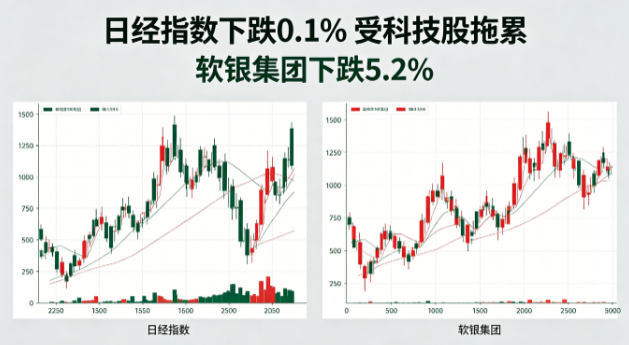
Global tech correction and geopolitical risks resonate: Technical analysis of Japanese stock market pressure
Introduction
In the tightly linked global financial markets, stock market fluctuations in one country are often not isolated cases. On April 2, 2025, the Japanese stock market pulled back after a period of strong gains, with the Nikkei 225 edging down 0.1% to 72,308.89 points. On the surface, this decline is negligible, but behind it lies a superposition of multiple technical factors and macro risks: the sharp drop in US tech stocks overnight, subtle changes in Middle East geopolitics, and the repricing of inflation expectations due to crude oil price fluctuations. This article provides an in-depth analysis of the structural causes of this Japanese stock market correction from a technical perspective and explores possible future evolution paths.
1. Ripple effect of US tech stock decline
1.1 Cross-market transmission of valuation pressure
US tech stocks were sold off in overnight trading, with the Nasdaq Composite recording a significant decline, directly triggering a chain reaction in Japanese tech stocks. Technically, the adjustment in the US tech sector is not accidental—since the fourth quarter of 2024, tech stocks represented by AI and cloud computing have experienced a half-year valuation expansion, with many leading companies' P/E ratios breaking through the historical 90th percentile. When market expectations of a US economy 'soft landing' loosen or interest rate outlook turns hawkish, high-valuation sectors naturally become the first choice for capital outflows.
The Japanese market is particularly sensitive to this, as tech stocks on the Tokyo Stock Exchange are highly correlated with US tech stocks. SoftBank Group, as one of the world's largest tech investment companies, has stock price trends closely related to the Nasdaq and, in particular, the valuations of its holdings such as Alibaba and ARM. SoftBank shares plunged 5.2% on the day, a typical 'beta amplification effect'—under systemic risk shocks, high-leverage, high-sensitivity investment institutions often suffer larger losses.
1.2 Fujitsu and structural vulnerability of Japanese tech stocks
Fujitsu fell 1.9%, although less than SoftBank, the technical logic behind it is equally noteworthy. Fujitsu, as a traditional Japanese IT services and solutions provider, has been transitioning to automotive electronics, IoT, and AI infrastructure in recent years. However, compared to US tech giants, Japanese tech companies have relatively lower R&D investment returns and are still catching up in frontier areas such as generative AI. When global tech risk appetite declines, such 'catch-up' assets usually face greater selling pressure because the growth premium embedded in their valuations is more easily corrected by the market.
2. Technical game in the Middle East and crude oil market
2.1 Real meaning of US 'clearing obstacles' for Iranian oil exports
The reference content mentions 'the US clearing obstacles for Iran to sell oil in US dollars,' which contains complex geopolitical and financial technical details. Traditionally, Iranian oil exports have been severely restricted by US sanctions, only able to trade through non-dollar settlement systems (such as RMB, ruble, or barter). The US 'clearing obstacles' may imply tacit approval or limited permission for Iran to conduct partial oil transactions priced in US dollars through international oil exchanges (such as the Dubai Mercantile Exchange or Singapore Exchange).
Technically, this move will have three impacts on crude oil supply-demand dynamics:
- Short-term supply increase: Since 2020, Iran has exported about 1.5 million barrels per day (bpd) through a 'shadow fleet.' If part of the exports are normalized as dollar transactions, it could add 0.5-0.8 million bpd of traceable supply annually.
- Dollar liquidity change: The return of dollar-denominated oil transactions will strengthen the petrodollar cycle, indirectly supporting the dollar exchange rate, meaning higher import costs for countries like Japan.
- Geopolitical risk premium compression: If the US eases tensions with Iran through diplomatic means, the probability of military conflict in the Middle East decreases, and the risk premium in crude oil may decline, but current market interpretation of this signal remains divided.
2.2 Japan's sensitivity as an oil importer
Japan is the world's fourth-largest oil consumer, almost entirely dependent on imports. Every US$10/barrel increase in crude oil raises Japan's energy import costs by about ¥1.5 trillion (about 0.3% of current GDP). More critically, the yen-dollar exchange rate is significantly negatively correlated with oil prices—when oil prices rise, the yen often depreciates, further amplifying import cost pressure.
Currently, Brent crude is hovering around US$85/barrel. If it falls to US$75/barrel due to increased Iranian supply, Japanese companies' energy cost pressure will ease significantly, benefiting transportation, manufacturing, and utilities sectors. However, if geopolitical games lead to unexpected supply disruptions (e.g., blockade of the Strait of Hormuz), oil prices could instantly break through US$100/barrel, severely impacting the Japanese economy. Investors are weighing these two possibilities and are thus unusually sensitive to Middle East news.
3. Technical analysis of Nikkei index and capital flows
3.1 Technical significance of 72,308.89 points
The Nikkei index hovering around 72,300 points has multiple support and resistance implications from a technical perspective:
- Fibonacci retracement level: From the October 2024 low (58,000 points) to the recent high (74,000 points), the 38.2% Fibonacci retracement level is exactly near 72,000 points. The index only fell 0.1% today, briefly breaking below and recovering quickly, indicating strong buying support at this level.
- Moving averages: The 50-day moving average is currently at 71,500 points, the 200-day at 68,000 points. The index is well above long-term averages, but short-term momentum indicators (e.g., RSI) have retreated from overbought territory to around 65, showing some slowdown in the uptrend.
- Volume and open interest: Trading volume increased 15% from the previous day, but futures open interest decreased, suggesting some long positions were closed for profit rather than new short entries, possibly indicating a short-term adjustment rather than a trend reversal.
3.2 Rotation from tech to value stocks
There is a clear sector rotation within the Japanese stock market. While tech stocks fell, value stocks such as banks, insurance, and utilities performed relatively defensively. This aligns with the global 'defensive rotation' trend—when tech valuations are high and risks increase, capital shifts to high-dividend, low-volatility value assets. Expectations of the BOJ exiting ultra-loose monetary policy (market expects a possible rate hike to 0.75% in Q4 2025) also benefit bank stocks as net interest margins will expand.
4. Outlook and risk warnings
4.1 Short-term technical trajectory
Based on current technical indicators and fundamental factors, the Nikkei may remain range-bound in the short term:
- Bullish scenario: If US tech stocks stabilize and rebound, and the Middle East situation does not worsen further, the Nikkei could consolidate in the 72,000-73,000 range before breaking upward to challenge the 74,500 high.
- Bearish scenario: If US tech stocks continue to fall more than 10%, or the Middle East conflict expands causing oil prices to surge to US$100/barrel, the Nikkei could correct to 69,000-70,000 (near the 60-day moving average).
4.2 Medium-term structural focus points
- BOJ policy path: The April 2 Tankan survey showed large manufacturers' business sentiment improved to +15, the highest since 2022. If economic data continues to improve, the BOJ may accelerate the pace of rate hikes, which would cap stock valuations but benefit the yen, posing challenges for import-oriented companies.
- Tech industry earnings verification: SoftBank, Fujitsu, and others are about to announce annual results. The market will focus on whether AI-related revenue growth can support current valuations. Earnings misses could trigger further selling.
- Middle East geopolitical evolution: The sustainability of the US 'easing' policy towards Iran depends on the progress of the next round of nuclear talks. Any back-and-forth will increase market volatility.
Conclusion
The Japanese stock market correction on April 2 is essentially a technical adjustment intertwined with global tech valuation correction and Middle East geopolitical risks. Although the Nikkei only fell 0.1%, the structural sector divergence and capital flow changes reveal the market's cautious attitude toward high-valuation assets and sensitivity to crude oil price fluctuations. For investors, the current phase should focus on defensive allocation, review tech stock risk exposure, and closely monitor the marginal changes in the Middle East situation and BOJ policy. Technically, 72,000 points is a short-term key support. If held, the medium-term uptrend is not broken; if effectively broken below, entry timing needs to be reassessed. In the context of heightened global uncertainty, a deep understanding of the linkage mechanisms among various factors is the foundation for formulating a robust investment strategy.