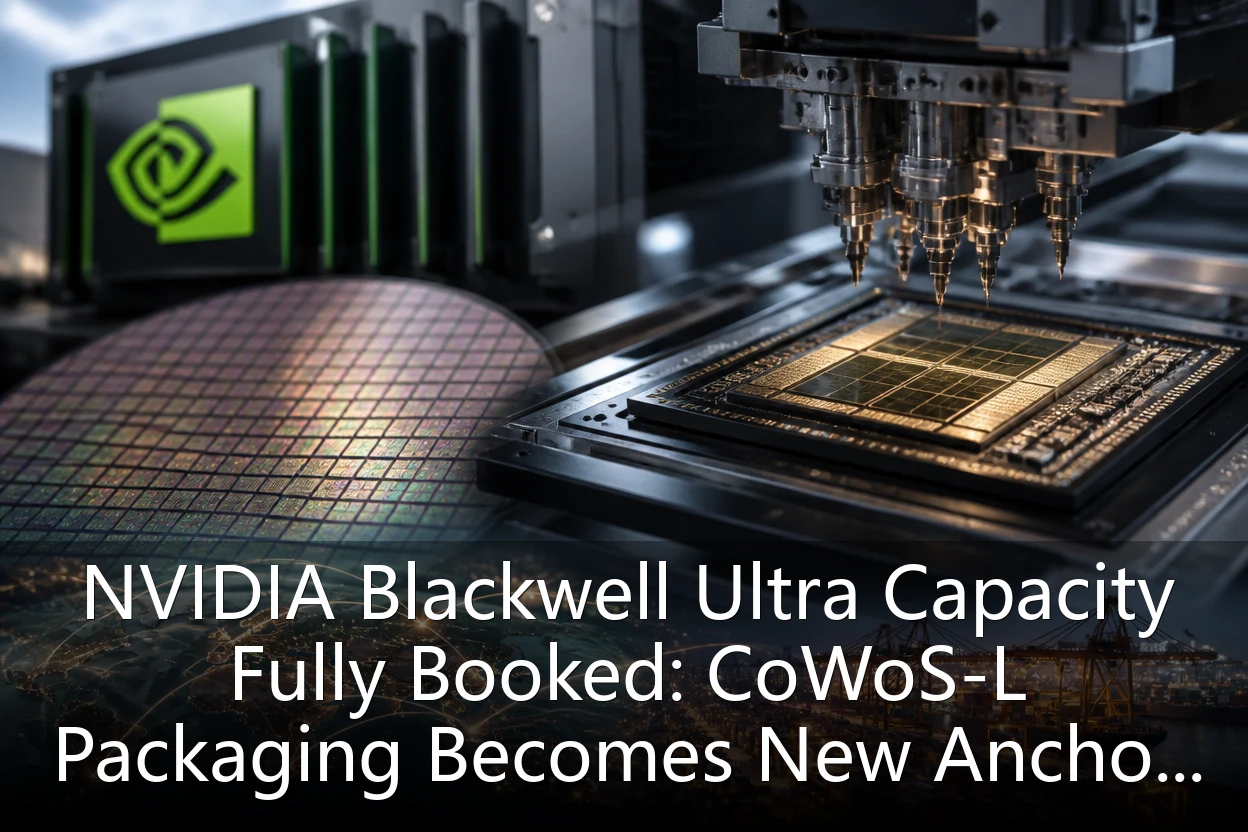
As demand for AI computing power continues to surge, the focus of global semiconductor investment is shifting from purely chasing advanced process nodes to the "back-end process"—advanced packaging. As of early August 2026, the shortage of NVIDIA's latest Blackwell Ultra architecture GPUs has not eased but has intensified due to rigid constraints in TSMC's CoWoS-L packaging capacity. This structural bottleneck is reshaping value distribution across the global semiconductor supply chain.
CoWoS-L Capacity Crunch: The "Barrel Effect" in AI Chips
According to the latest supply chain reports, TSMC's advanced packaging facilities in Taiwan are operating at overload, with CoWoS-L (Chip-on-Wafer-on-Substrate with Large Interposer) capacity utilization for NVIDIA's Blackwell Ultra series surging to nearly 100%. Although TSMC urgently expanded capacity by about 30% in the first half of 2026, a capacity gap of over 20% remains amid a flood of orders from giants like NVIDIA, Broadcom, and AMD. Based on current production schedules, lead times for some AI accelerator cards have extended to mid-2027.
This directly reveals a harsh reality: advanced packaging is replacing wafer fabrication as the biggest bottleneck in AI chip supply. NVIDIA CEO Jensen Huang stated in a recent closed-door meeting: "We have enough designs and logic chips, but how to efficiently combine these chips together is the biggest physical challenge right now."
Capacity Spillover: Southeast Asian Packaging Giants Reap Windfall
TSMC's capacity constraints are forcing NVIDIA to accelerate a decentralized packaging strategy, outsourcing a large number of back-end processes to traditional OSAT (Outsourced Semiconductor Assembly and Test) leaders. This strategic shift has directly ignited the performance of ASE and Amkor.
ASE Technology Holding's latest Q2 2026 financial report shows its advanced packaging revenue grew over 40% year-on-year, hitting a record high. To handle NVIDIA's overflow orders, ASE's newest advanced packaging plant in Kaohsiung has started mass production ahead of schedule, specifically serving high-performance computing chip packaging needs. Meanwhile, Amkor Technology has also massively expanded its high-end packaging lines at its Vietnam facility, directly benefiting from the migration of AI chip packaging capacity.
More notably, traditional chip packaging is leaping from labor-intensive to technology-intensive. While CoWoS technology is led by TSMC, its interposer manufacturing, wafer testing, and final substrate assembly steps offer significant value growth opportunities for OSAT players with advanced capabilities. This also means that the valuation logic for companies capable of absorbing such technology spillovers will shift from traditional packaging and testing foundry to advanced packaging solution provider.
Investment Logic Restructured: From Investing in Computing Power to Investing in Connectivity
For investors, the CoWoS-L capacity bottleneck signals an important investment shift: the ROI of AI chips no longer depends solely on transistor density, but on data transfer speed and energy efficiency. This directly benefits two key sub-sectors:
- Advanced Packaging Equipment and Materials: To achieve extremely high-precision interposer interconnects, demand for laser drilling, precision electroplating, and high-purity glass substrates is surging. The technical advantages of Japan and Germany in this area are translating into strong stock performance.
- Southeast Asian Packaging Industry Upgrade: Thailand and Malaysia are transitioning from traditional wire bonding to flip-chip and fan-out packaging. As NVIDIA shifts some mid-to-back-end packaging processes to Malaysia, local semiconductor parks with advanced cleanrooms and automated production capabilities are becoming new targets for global capital.
Risks and Outlook: When Will Supply Catch Up with Demand?
Although TSMC plans to boost monthly CoWoS-L capacity to over 80,000 wafers by 2027, the larger size and higher packaging precision requirements of NVIDIA's Blackwell series chips mean actual capacity loss rates are high. Analysts expect the tight supply-demand situation for advanced packaging to persist at least until the end of 2027.
For retail investors, while keeping an eye on AI chip design leaders like NVIDIA, looking downstream into the packaging supply chain—especially OSAT players and material suppliers with a presence in Southeast Asia—may be the best strategy to capture AI dividends in the second half of 2026. After all, in the era where computing power is king, the ability to package that power is itself a scarce resource.